Category Archives: Articles

Lovecraft, Lucretius, and Leonard’s Locomotive-God: Further Thoughts on Cosmic Horror

This post is a companion to and continuation of “‘The Dread Contemplation of Infinity’: Some Thoughts on George M. Gould and Cosmic Horror Before Lovecraft,” Where that essay explores how Lovecraft’s conception of cosmic horror is best understood as a transvaluation of that which predominated from the 1880s through to the 1930s, this essay further explores Lovecraft’s developing conception of cosmic horror by focusing on another of Lovecraft’s under-recognized contemporary influences; namely, the American professor, poet, memoirist, and translator, William Ellery Leonard. This post is based on the conference paper, “From Beyond the Pleasure Principle: Freud, Lucretius, Lovecraft and The Locomotive-God,” which I presented as part of the Henry Armitage Symposium at NecronomiCon in August, 2019. Some of the material on Lucretius, Poe and Lovecraft in the first section is drawn from my essay “The Poet’s Nightmare: The Nature of Things According to Lovecraft.” If you want a more developed (and fully cited) version of that material, you’ll find it there.

Much of this material will be further developed in my in-progress book, tentatively titled Repulsive Influences, which provides a genealogy of cosmic horror while exploring the intersecting histories of Lucretius’s reception and the emergence of Anglophone gothic, horror and weird fiction.

William Ellery Leonard (1876-1944)

LEONARD, LUCRETIUS AND LOVECRAFT

The first American to publish a complete English translation of Lucretius’s epic didactic poem De rerum natura was a professor of Classics at the University of Wisconsin named William Ellery Leonard (for an extensive study of Leonard’s life and work, see Neale Reinitz’s The Professor and the Locomotive-God.)

While his work is little read today, Leonard was among the most widely known American writers of his day, renowned both for his translations of Greek, Roman and Anglo-Saxon poetry and for his own poetry and his two memoirs, Two Lives and The Locomotive-God. The latter focuses entirely on the traumatic phobia that overshadowed Leonard’s life, and was widely read, both by psychologists (including Freud, whose correspondence with Leonard became part of the book) and general readers who were fascinated by Leonard’s minute, dramatically written analysis of his own “case.” Lovecraft thought highly of The Locomotive-God as a psycho-biographical memoir, and his curiosity regarding Leonard was no doubt intensified because, while it does not appear they ever met personally, they had only two degrees of separation via a number of members of Lovecraft’s Circle. Both men were friends with August Derleth, who was among Leonard’s pupils, and both also wrote appreciations of Frank Belknap Long’s writings

Quite apart from their shared social connections, Leonard’s writings bear importantly upon Lovecraft’s in ways that have, to my knowledge, never been critically explored. This essay focuses on two apertures through which Leonard’s work influenced Lovecraft’s developing conception of cosmic horror.

EDGAR POE AND LUCRETIAN COSMICISM

The first occurs in 1916, with the publication of Leonard’s translation and interpretations of Lucretius, On The Nature of Things. Leonard’s translation includes an end-note appended to the first instance of his use of the term Cosmos in translating part of Lucretius’ opening Hymn to Venus (DRN I 21). Leonard justifies his lexical choice by writing:

“In Greek, a technical term of that Stoic philosophy to which Lucretius was opposed; but in English fairly equivalent to the Epicurean “natura rerum,” through the associations of the word with Spencer’s “Cosmic Philosophy” and with modern materialism.”
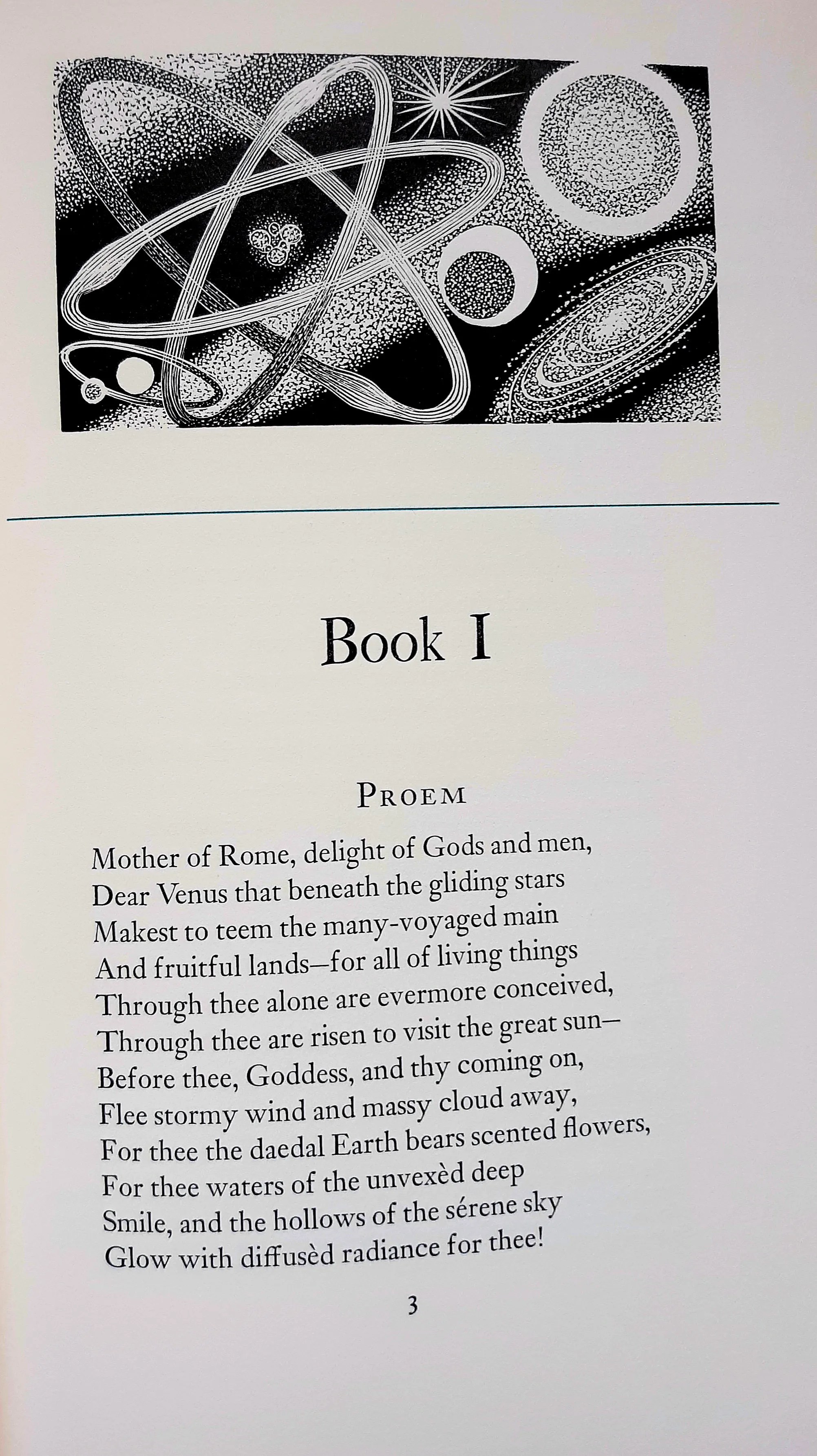
Paul Landacre’s illustrations for the Limited Edition Club’s 1950s reprint of Leonard’s translation beautifully capture the cosmic sensibility of the poem.

Lucretius’s avoidance of the Greek word cosmos is informed by its teleological connotations, but Leonard suggests that these connotations need no longer apply given the term’s adoption by modern materialist thinkers. Lovecraft seems to have shared Leonard’s view in this respect, as his adoption of the term cosmicism to characterize his own philosophical sensibility suggests. Indeed, Lovecraft’s cosmic vision, following from Lucretius’s, is radically opposed to teleological assumptions about the natural world. S.T. Joshi writes:

“The central tenet in what Lovecraft called his “cosmic indifferentism” is mechanistic materialism. The term postulates two ontological hypotheses: 1) the universe is a “mechanism” governed by fixed laws (although these may not all be known to human beings) where all entity is inextricably connected causally; there can be no such thing as chance (hence no free will but instead an absolute determinism), since every incident is the inevitable outcome of countless ancillary and contributory events reaching back into infinity; 2) all entity is material, and there can be no other essence, whether it be “soul” or “spirit” or any other non-material substance. Lovecraft evolved these ideas through a lifelong study of ancient and modern philosophy, beginning with the Greek Atomists (Leucippus and Democritus), their followers Epicurus and Lucretius (whose belief in free will Lovecraft was forced to abandon), and such modern thinkers as Ernst Haeckel, Thomas Henry Huxley, Friedrich Nietzsche, Bertrand Russell, and George Santayana. Lovecraft’s metaphysical views seem to have solidified around 1919, when he read Haeckel’s The Riddle of the Universe (1899; English translation 1900) and Hugh Elliot’s Modern Science and Materialism (1919).”

What effect Leonard’s translation and commentary may have had in shaping Lovecraft’s philosophical views is difficult to determine; in all likelihood, it was probably minor. The verbal and aesthetic parallels between Leonard’s translation and some of Lovecraft’s writings from this period, however, are intriguing, and particularly the “Aletheia Phrikodes” section of Lovecraft’s 1918 poem “The Poe-et’s Nightmare.” While the larger poem’s mock-epic structure is a love-letter from Lovecraft to his Augustan idol Alexander Pope, once called the “English Lucretius,” the “Aletheia Phrikodes” section is a cosmic stew in which blank verse Lucretian imitation is peppered with allusions to Edgar Allan Poe, beginning with the longer poem’s original title itself. One brief section serves to illustrate how Lovecraft twines Lucretius and Poe together:

Whilst whirling ether bore in eddying streams
The hot, unfinish’d stuff of nascent worlds
Hither and thither through infinity
Of light and darkness, strangely intermix’d;
Wherein all entity had consciousness,
Without th’ accustom’d outward shape of life.
Of these swift circling currents was my soul,
Free from the flesh, a true constituent part;
Nor felt I less myself, for want of form. (italics mine)
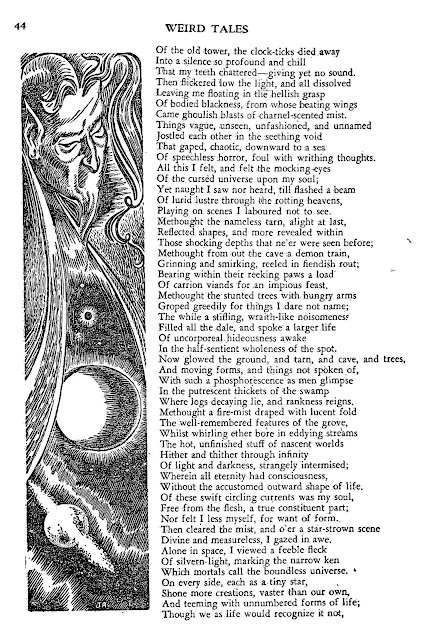
The visual interplay between Jon Arfstrom’s illustrations for Lovecraft’s poem in Weird Tales and Landacre’s illustrations for Leonard’s Lucretius is striking.

At once cosmogony and nekuia, The passage is part of an extended improvisation on both DRN V’s astronomic and meteorological passages and DRN III’s descriptions of the soul’s perishable materiality, but it also invokes Poe’s cosmic vision in early poems like “Al Aaraaf” and the cosmological prose poem, Eureka. In describing these fluctuating vortexes of metamorphic materiality as “eddying” streams, Lovecraft emphasizes the Poe-etic nature of this cosmic maelstrom.

That Lovecraft and Leonard shared an appreciation for Poe as cosmic visionary, a sort of American Lucretius, is certain. Such a view had been propounded by James A. Harrison, in his 1902 edition of Poe’s collected works; Harrison declared that “Both, in their poems, were passionate inconoclasts, idealists, dreamers of the speculative philosophies that looked into the causes of things; both set aside what they considered the degrading superstitions,” and were “refined materialists of an almost spiritual type,” which likely shaped both Lovecraft and Leonard’s associations between Lucretius and Poe.

Poe’s work is rife with eddying whirls and turbulent vortices, some of which spiral down into the oceanic depths, others of which whirl up and out through the unfolding universe of stars. Indeed, the spiral, in the dynamic form of the vortex, is the most pervasive and important motif in Poe’s writings, and engenders his aesthetics of the grotesque and arabesque, as Patricia Smith observes:

“The arabesque as Poe sees it is an attempt to suggest something kinetic — the motion toward unity — in a static medium; symbolically, it is always moving in the direction of the form-obliterating spiral. The man whirling about on Aetna resolves all he sees into a radical blur by means of his spin; the universe itself, in Eureka, collapses ultimately into a state of nihility. As in the Maelstrom, where all things “meet together at the bottom,” the final vision toward which the arabesque points is one in which unity is perceived, and it is impossible to distinguish one thing from another.”

Poe’s vortexes reflect his materialist metaphysics, which in turn derive from his own transformative reception of the classical atomist influences he shares with Lovecraft. Whether Lovecraft had read Leonard’s entire translation before drafting his poem is unclear, although he was certainly aware of its existence, and likely to have seen excerpts, as it was widely reviewed and noticed. That he had done so by 1922 is almost certain, as he mentions it approvingly in a letter to Lillian Clark, while noting that Derleth gifted a copy to Sonia Greene : “The generous little divvle is making presents on a large scale–Smith’s ‘Star Treader’ for me, an art book for Kid Belknap, & Leonard’s translation of Lucretius for Mrs. Greene–with whom he is trying to make up after his rudeness of last spring. Leonard is his English professor at the U. of Wis.–a scholar of note.”  

Leonard’s phrasing reinforces the resemblance between this passage in DRN and Poe’s description of the whirlpool in “A Descent into the Maelstrom,” a tale that signals its own atomistic underpinnings by both its epigraphic reference to the Democritean δῑ́νη and its deliberate echo of Lucretius’s most famous passage, the “suave mari magno” description of a shipwreck that opens DRN II.
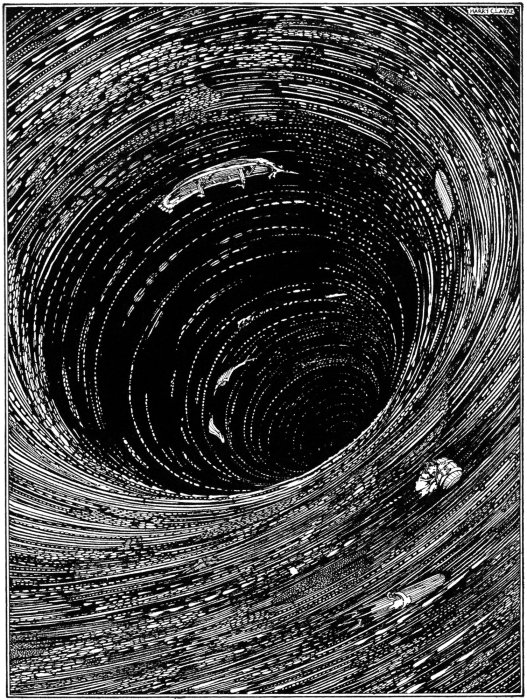
Harry Clarke’s illustration (1919) for Poe’s “Maelstrom,” much admired by Lovecraft.

Leonard makes his Poe-tical homage even more evident a few pages later. Lucretius provides a naturalistic explanation for the absence of birds at Greek oracular sites including Cumae, an absence traditionally attributed to the awful supernatural influence of the gods. Instead, Lucretius explains that noxious gases that leak forth from the earth keep the birds away from such sites, which Leonard renders as “birdless tarns,” echoing Poe’s use of this antiquated term in describing the miasmic body of water into which the House of Usher falls. Leonard’s translation reads:

            And such a spot there is

            Within the walls of Athens, even there

            On summit of Acropolis, beside

            Fane of Tritonian Pallas bountiful,

            Where never cawing crows can wing their course,

            Not even when smoke the altars with good gifts,–

But evermore they flee—yet not from wrath

Of Pallas. (VI.280)

This echo of  “The Raven” suggests, much as “The Poe’et’s Nightmare” does, Poe’s concatenation with Lucretius. Whether Lovecraft had read all of Leonard’s translation at this stage is unclear, but it nonetheless telling that both writers, soi-disant opponents of Poundian Modernism, returned to the Democritean δῑ́νη via such parallel descents.
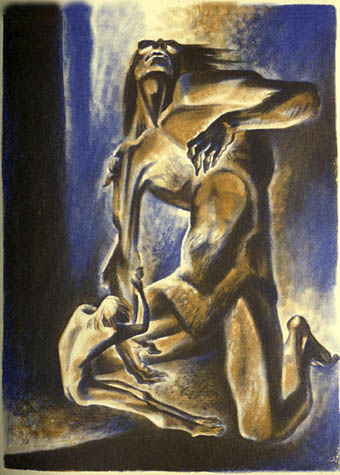
Beowulf battling Grendel in one of Lynd Ward’s illustrations for Leonard’s translation.

LUCRETIUS, FREUD AND LEONARD’S LOCOMOTIVE-GOD

A decade before Leonard published his 1927 psycho-biographical account of his phobic obsessions, The Locomotive-God, his often- incapacitating agoraphobia was already reflected in the anxious intensity and alienation of his translations. In Leonard’s Lucretius, the descriptions of immensity and the void and the characterization of the monstrous Religio are particularly harrowing, as are his renditions of Grendel and the dragon in Beowulf, and each of these draws force from the compulsive power of Leonard’s growing anxiety.
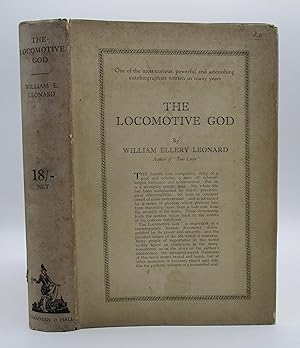
The cover of a 1928 printing of The Locomotive-God

 Leonard’s phobia worsened considerably after 1918, in the wake of the catastrophic First World War. Near the opening of the book, Leonard writes:

“What was so poignantly my subconscious mind reveals itself, by the laws of our most common organic structure and development, as the mind of mankind. My own pain, my own struggle, has been, even to myself, a spectacle, a laboratory. And my findings differ in some ominous particulars from the previous record of poets and psychoanalysts. I have been persuaded […] by the desire to frustrate, by a neat and unexpected turn, those Demonic Forces which, as appearances go, have backed me for so many years against the wall. Beset by phobias, shell-shocked in a civilian war […] So out of very suffering and very failure I would create value: the value of a scientific document, the value of a work of art.”

When atoms meet in the void through the clinamen, they can combine, or they can collide. Thus, attraction and repulsion are the fundamental principles of Epicurean physics. Lucretius, however, renders these in mythological terms derived primarily from Empedocles: Venus is a personification of attraction and combination, and Mars of repulsion and collision. In his post-war writings, especially Beyond the Pleasure Principle, Freud returns to such an Empedoclean mythic polarity with his conception of The Death Instinct as a counter to the Pleasure Principle.

It is a conception inspired, as W. Scott Poole emphasizes in his study of the Great War’s decisive influence on modern horror, by Freud’s horror at the catastrophic consequences of the war, consequences that Leonard also believed to have intensified his phobia, amplifying the power of the Locomotive-God over his mind and behaviour.

Leonard expresses this revelation in terms that are both explicitly Freudian, and explicitly Lucretian:  “The “love-emotion” “could relive but not break the tension of the tangled mythology in which the subconscious in its deepest levels still believed…and still believes. The Locomotive-God won even against Aphrodite, goddess of manhood.”

The Locomotive-God traces Leonard’s trauma-induced phobic paralysis to a memory from his early childhood. As a two-year-old-child, he stood on a platform and watched a train pulling into the station. Disregarding his mother’s cries, he wandered to the edge of the tracks, until:

“It towers and lowers and grins in one awful metamorphosis, more grotesque than the most bizarre dreams of Greek mythology […] As It roars over the bridge […] scattering dust and strewn newspaper, the black circle of the boiler-front swells to the size of the round sky out of which the Thing now seems to have leaped upon me [….] this Aboriginal Monster. My eyeballs, transfixed in one stare, ache in their sockets.”

This terrifying memory would superimpose itself over, and come to stand for, every subsequent traumatic event Leonard would experience in his life. He writes,

“To me at a little more than two years, the Black Circle flashes a fiercely shaking Face of infinite menace, more hideous and hostile than Gorgon-shield or the squat demon in a Chinese temple, with gaping Jaws, flanked by bulging jowls, to swallow me down, to eat me alive—and the Thing is God […] God roaring from heaven to slay me for having disobeyed my mother and gone so close to the track.”

As an older child, Leonard would witness a cat struck by a train, which triggered the original trauma: “the cat got tangled up in the unseen web of my thought with the instrument of its death—the locomotive.” This led Leonard to claim that “terror is the supreme emotion of life, and it borrows its color from its Master, Death.”

As Leonard wrote his translation of Lucretius, “the Thing” would colour his descriptions not just of the immensities of the void, but also the description of Religio, Lucretius’s figuration of religion as a feminized embodiment of irrational compulsive power, that very force that Epicureanism is supposed to overcome. It is a figuration that resounds throughout Lovecraft’s non-fictional writings on atheism as clearly as his tales of malignant cults. Leonard speculates that “Much that we call Superstition is really Phobic Fear, not understood as such by the victim or those who gird at the victim; even as Phobic phenomenon have surely been a prime source, feeding the speculations and prepossessions of theologies pagan and Christian, of the belief in witchcraft.”

LOVECRAFT AND THE LOCOMOTIVE-GOD

            The Locomotive-God’s influence on Lovecraft has gone largely unremarked, but it is hard to overstate its importance. More than any other single influence, it led Lovecraft further away from Gould’s predominant conception of cosmic horror, and helped cement for him the importance of the work on the nature of horror being done by psychologists including John B. Watson (on which see Dr. Sharon Packer’s essay) and Freudian psychoanalysis.

Leonard’s characterization of terror as “the supreme emotion of life” resonates powerfully with that with which Lovecraft begins his own 1927 essay on supernatural horror. Leonard’s frenetic description of the Locomotive-God, with its fusion of animal and vehicle, raw machinic power and perverse vitality, industrial modernity and primordial psychic dread, resonates powerfully with many of Lovecraft’s post-1929 monsters; most obviously, the shoggoths of 1931’s At the Mountains of Madness derive much of their terrifying imagery and potency from Leonard’s Locomotive-God.

Illustration of a shoggoth from At the Mountains of Madness by Nottsuo from Deviantart.

In a 1929 letter to Derleth, Lovecraft acknowledged Leonard as “A character, & a figure of real importance in American letters.” By this point, he had read The Locomotive-God, and his letters praise the penetrating psychology of traumatic obsession that Leonard’s book offers. For example, a 1931 letter recommends it to Robert E. Howard as essential reading for anyone interested in psychobiography. As his recommendation to Howard reinforces, The Locomotive-God was crucial to Lovecraft’s conception of the power of atmosphere, the sine non qua of cosmic horror. Leonard’s provision of a mechanistic explanation for his own psychic trauma was especially valuable to Lovecraft as of 1931, as at this stage in his career he was explicitly looking for ways to generate “an atmosphere” of cosmic dread without turning to the superstitious tropes of classic supernatural horror.  Leonard writes,

“The mechanism in its technique can be made clear to the reader. We start with a state of terror generated by past experience. The past experience itself remains in the subconscious. Its emotional effect, terror, bursts into consciousness. At times the emotional effect remains merely a diffused state of terror, in intensity running the whole scale from vague anxiety to intensest feel of impending death; and the agonized mind stands balked of any explanation whatever.”

Lovecraft later praises Leonard’s insight into his phobic experiences in a 1931 letter to Maurice Moe: “Unless one is steeled against the ascendancy of the capricious and meaningless subjective feelings, he is lost so far as the power of rational appraisal of the external world is concerned. Thus poor W. E. Leonard sees and feels things that aren’t there–and knows he does–yet continues to see and feel them just the same. That shows the power of irrational mood over rational perception.” It is precisely this power that, from 1927 on, Lovecraft, departing further from Gould’s nineteenth-century medico-theological concept, sees as the sine non qua of the best supernatural horror fiction, and, reinforcing his adoration of Poe, comes to term an “atmosphere” of “cosmic dread.”


.
Tagged , , , , , , , , , , , , , , , , , , , , , , , , , ,

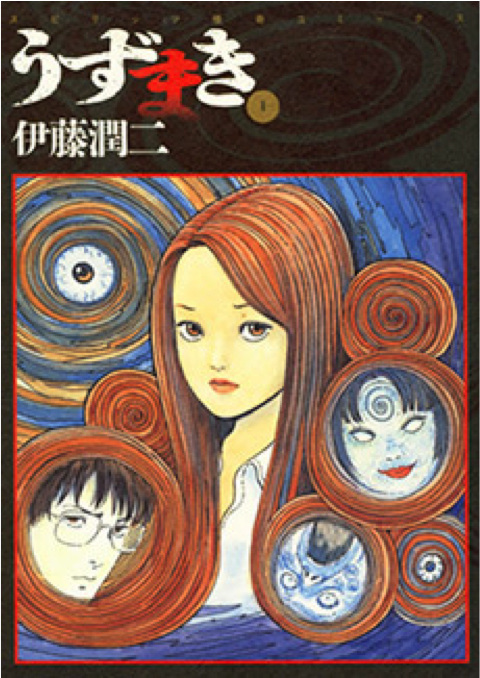
The Downward Spiral: Thoughts on Lovecraftian Spirality and Ito’s Uzumaki

By Sean Moreland

This informal and image-driven essay is loosely based on two closely related conference papers. The first was given as part of the academic track of NecronomiCon, in Providence, RI, August 2017. The second was delivered as part of the Visual & Performing Arts & Audiences Division at the International Conference on the Fantastic in the Arts in March, 2018. I further develop my analysis of the relationship between Lovecraft’s “cosmic horror” and the aesthetics of the sublime in the essay “The Birth of Cosmic Horror from the S(ub)lime of Lucretius,” in New Directions in Supernatural Horror Literature. My analysis of the significance of spiral motifs in Lovecraft, and especially in his writings up to 1927, is developed in the article “Stages of The Spiral: Lovecraft’s Descent into the Maelstrom,” which will appear in the collection Lovecraftian Proceedings Volume 3, forthcoming summer 2019 from Hippocampus Press. Eventually, these ideas will be more fully developed as a chapter in my book-in-progress, Repulsive Influences: A Historical Poetics of Atomic Horror.

***

Untitled


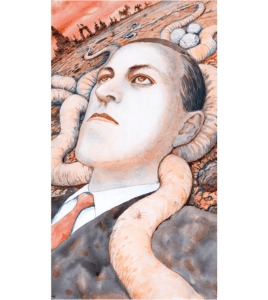
Asked in an interview about the influences on his magnum opus of comic-cosmic horror, Uzumaki, renowned mangaka Junji Ito replied that the “different stages of the spiral” visualized by the book “were definitely inspired from the mysterious novels of H.P. Lovecraft.”

As Ito’s remark suggests, Uzumaki responds to and adapts Lovecraft’s spirals as figurations of cosmic horror, figurations profoundly influenced by Lovecraft’s own historical, cultural, and scientific context.

Untitled

HPL ala Ito


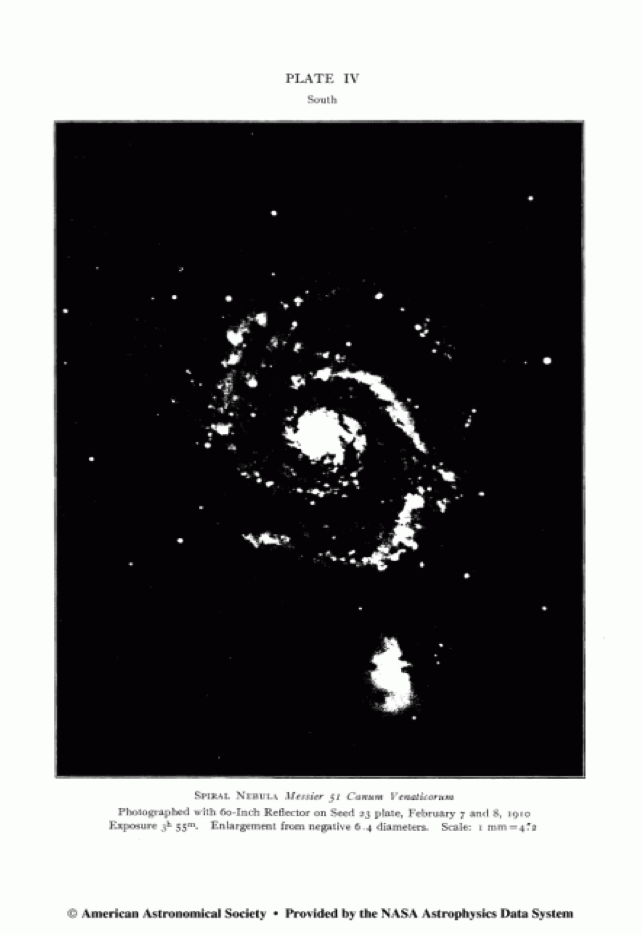
In Lovecraft’s writings, spirals initially figure visible cosmic order and scientific discovery, as suggested by his excited responses to early photographic images of the spiral nebula. In 1917, Lovecraft wrote:


“A recent discovery of immense importance to our knowledge of the structure of the universe is that of the incredibly rapid rotation of certain large spiral nebulae… how rudimentary is our present information regarding the larger outlines of the visible creation wherein we dwell.”

Untitled

G.W. Ritchey’s 1910 photoplate of the M51 spiral nebula


In Lovecraft’s writings as of 1918, however, beginning with “The Poe-et’s Nightmare,” spirals increasingly come to figure disorder and chaos, an association intensified by Lovecraft’s gradual acceptance of the cosmic consequences of the second law of thermodynamics, contemporaneously with what he called the “maelstrom” of the First World War’s chaotic violence. As Lovecraft puts it in a 1923 letter to Frank Belknap Long:

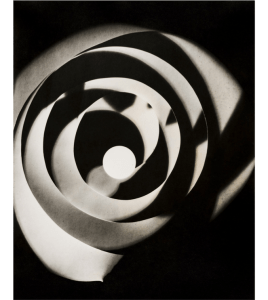
“In art there is no use in heeding the chaos of the universe. I can conceive of no true image of the pattern of life and cosmic force, unless it be a jumble of mean dots arrang’d in directionless spirals.” It is a remark Lovecraft makes by way of criticizing the “chaotic” work created by Modernist and surrealist writers and artists, which (futilely, to his mind) attempts to reflect the (dis)order of existence by eschewing traditional formal structures.

Untitled

1923 spiral photograph by Man Ray


Without explicitly referring to Lovecraft, Uzumaki  provides a powerful realization of how spirals in his writing figure at once an ordered, mechanistic and predictably determinate universe, and a chaotic and unknowable one. I take Ito’s acknowledgement of Lovecraft’s influence as a license to frame Uzumaki (perhaps perversely) in terms of the context of Lovecraft’s work, although this necessarily means  tearing it from the context of Japanese cultural, narrative and visual traditions in the late 20th century. Largely excluded from my discussion, for example, are Uzumaki’s connections to Ero-Guro-Nansensu, the spiral patterns of Hokusai’s ukiyo-e, Ito’s parodying of conventions of popular romance manga, or his homages to fellow horror mangaka Kazuo Umezu.

e37ce6069c05955f420b3fe5a1c65572 (1)

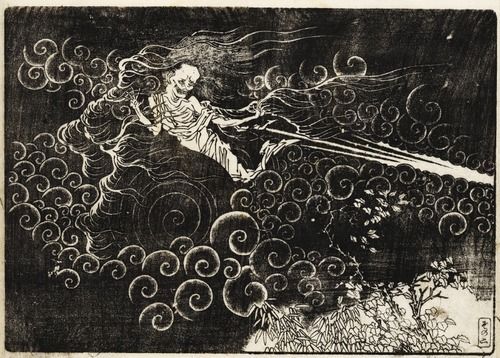
Katsushika Hokusai’s ukiyo-e often feature spiral motifs, including many of his “laughing demon” images and the better-known Great Wave off Kanagawa.

Similarly, I don’t explore the topic of Lovecraft’s wider cultural reception in Japan. Readers interested in this topic should see Hisadome Kenji, “The Cthulhu Mythos in Japan,” trans. Edward Lipsett, Night Voices, Night Journeys Volume One: Lairs of the Hidden Gods, edited by Asamatsu Ken (Fukuoka: Kurodahan, 2005), 339-352,. Those interested in HPL’s pervasive influence in manga and anime could start with Jason Thompson’s NSFW piece here.

Unlike artists Osamu Tezuka, Richard Corben, John Coulthard, or Ian Culbard, Ito has never produced a literal adaptation of Lovecraft’s stories. Unlike Alan Moore, he is not known for his re-imaginings of Lovecraft’s characters or plots; nevertheless, Ito is among the most important visual interpreters of Lovecraftian cosmic horror, and Uzumaki is his greatest expression of it to date. Ito is open about Lovecraft’s influence; he remarks, with apposite vagueness, that Lovecraft’s expressionism with regard to atmosphere greatly inspires my creative impulse.” Ito’s characterization of Lovecraft echoes Lovecraft’s own definition of weird fiction in Supernatural Horror in Literature, which emphasizes “A certain atmosphere of breathless and unexplainable dread of outer, unknown forces,” and “a malign and particular suspension or defeat of those fixed laws of Nature which are our only safeguard against the assaults of chaos and the daemons of unplumbed space.”

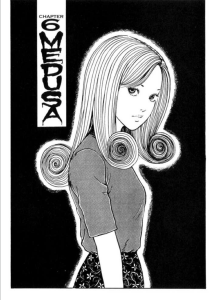
Uzumaki provides such a suspension by visualizing the gradual speiromorphosis of a coastal Japanese town, portraying an ensemble cast of ill-fated characters while often focusing on the futile escape attempts of two students, Kirie Goshima and Shuichi Saito. Uzumaki offers a few implicit homages to Lovecraft’s stories, particularly with the chapter “The Medusa,” reminiscent of Lovecraft’s collaboration, “Medusa’s Coil” (minus the viciously racializing subtext.)

Untitled

Junj Ito, Uzumaki, trans. Yuji Oniki (San Francisco: VIZ Media, 2010)

However, Ito’s interest in the epistemological and aesthetic roots of Lovecraft’s spiral obsession is most evident in the “lost” chapter of Uzumaki, making it an effective bridge between the early 20th century astronomical context of Lovecraft’s cosmic horror and the turbulent transfigurations of Uzumaki as a whole.

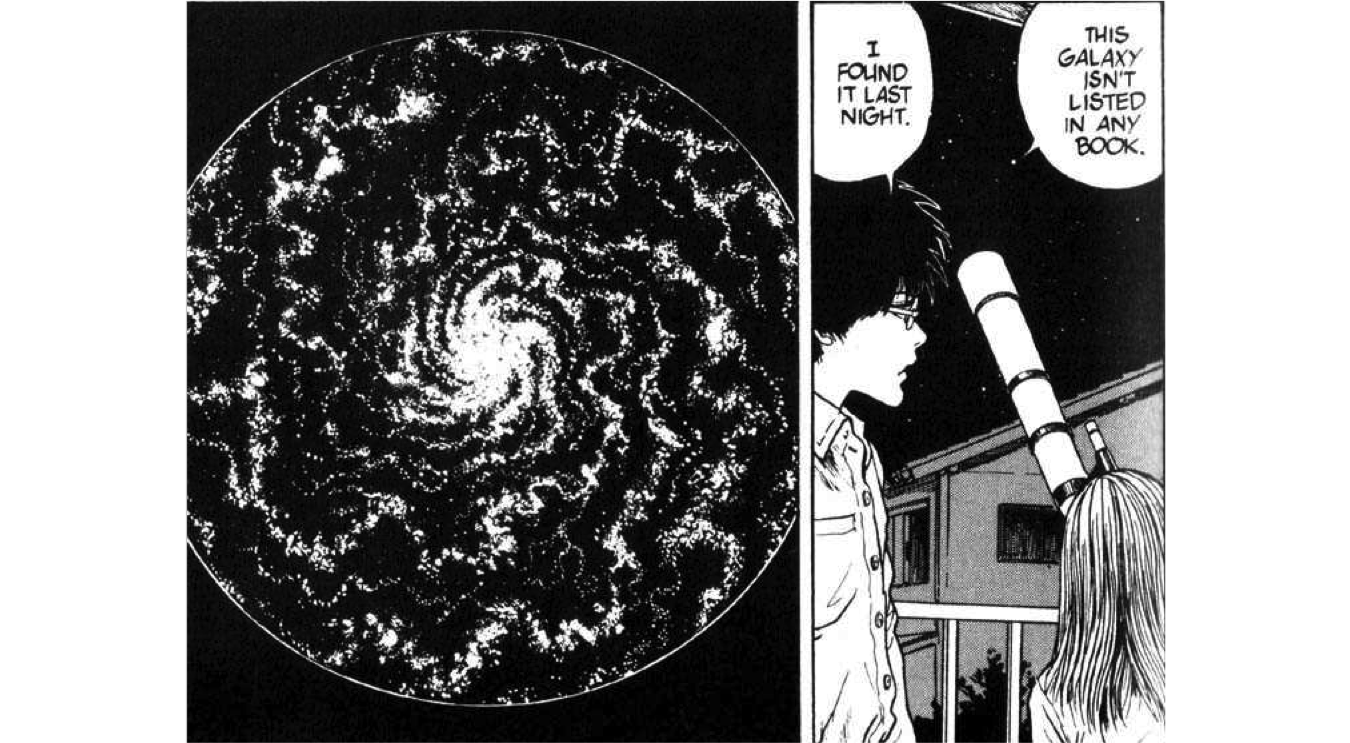
Called “Galaxies,” this chapter is disconnected from the rest of the arc, appearing in the VIZ omnibus edition as a sort of postscript. “Galaxies” introduces the spiral as an alien astronomical phenomenon.

Untitled

Junj Ito, Uzumaki, trans. Yuji Oniki (San Francisco: VIZ Media, 2010)

It begins with Shuichi telling Kirie that he has discovered a galaxy that “isn’t listed in any book,” insisting she look through his telescope to see for herself. Kirie is the visual focus of the opening panels; the reader looks at her. With the fourth panel, we see the spiral phenomenon for the first time through her eyes, a traditional suturing technique in both comics and film.

We see the human locus of our identification, then we see the supernatural threat through their eyes, then we see their reaction to it, and so on. Inside the panel’s square borders is a circular secondary border representing the telescopic lens. Inside that, a twisting spiral stellar formation, strongly reminiscent of early photographs of the spiral nebulae.

The next page shifts scenes and elides time, showing Kirie at school, telling her science teacher about the discovery. While skeptical, he agrees to ask his friend, “an armchair astronomer” to verify Shuichi’s find. Another turn of the page brings the reader to that night, and the home of Torino, struck with manic elation when he sees the spiral galaxy for himself (617). The discovery leads to “a sudden astronomy boom” in Kirie’s school, the “new” galaxy becoming an object of community-wide obsession. This obsession is especially powerful for Shuichi and Torino, who both experience “radio waves”  emanating from “some entity” in the spiral galaxy, an echo of the interstellar telepathic communication practiced by many of Lovecraft’s alien entities.

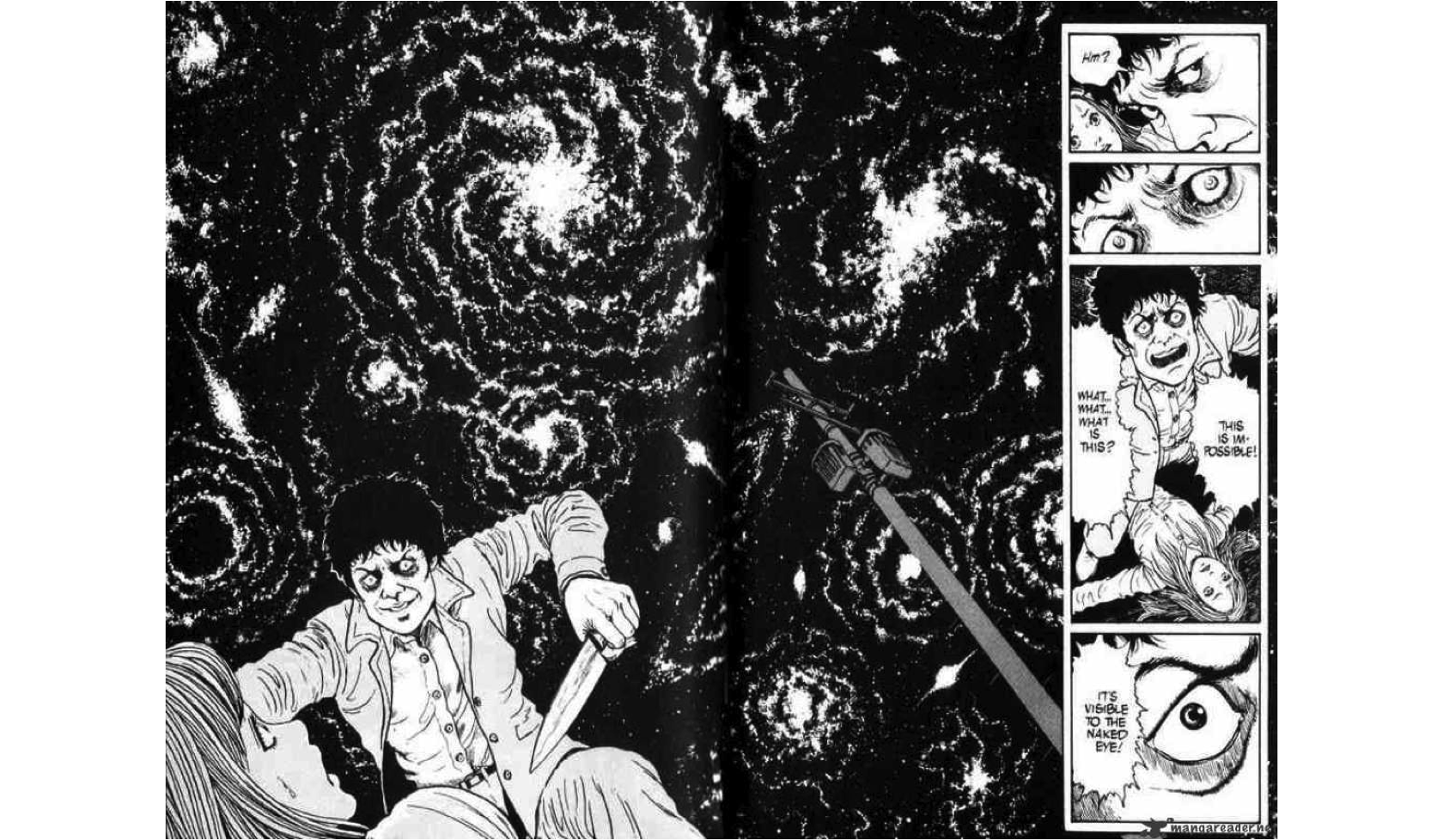
Shuichi is desperate to escape this nefarious astral influence, while Torino wants to use it to glorify himself. He tells Shuichi that he must kill him, in order to get credit for the discovery. Eventually, more new galaxies are discovered, emerging as if in correspondence with the individual subjectivities of the town’s residents, beckoning each of them to their own particular sidereal dissolution, a conceit closely related to that at the heart of Ito’s manga, The Enigma of Amigara Fault. Delirium and violence ensue, culminating in Torino’s attempts to kill Kirie, who objects to his taking credit for Shuichi’s discovery:

Untitled

As he overpowers her, the sky behind him erupts into a swirling mass of stellar spirals. Kirie is spared as Torino shouts up to the swirling mass of stars, demanding they acknowledge him as their discoverer; he is then swept up in a cosmic whirlwind, his head twisting into a nested series of spirals, until it explodes outwards and up, turning into a small galaxy and surging up to the heavens.  “Galaxies” is a grotesque mockery of the anthropocentric hubris of the romantic sublime, in which the object is observed, absorbed, and used to stabilize and elevate human subjectivity. Instead of this stabilization, Torino is translated into an astronomical object himself, displaying what Vivian Ralickas, with reference to Lovecraft’s stories, calls an “inherent, anti-humanist critique of sublimity.” Ito follows Lovecraft in revealing the pseudo-apotheosis of religious and romantic sublimes to be ridiculous, while expressing this absurdity in images that are themselves sublime; stellar nebulae, hurricanes, whirlpools, cyclopean subterranean structures.

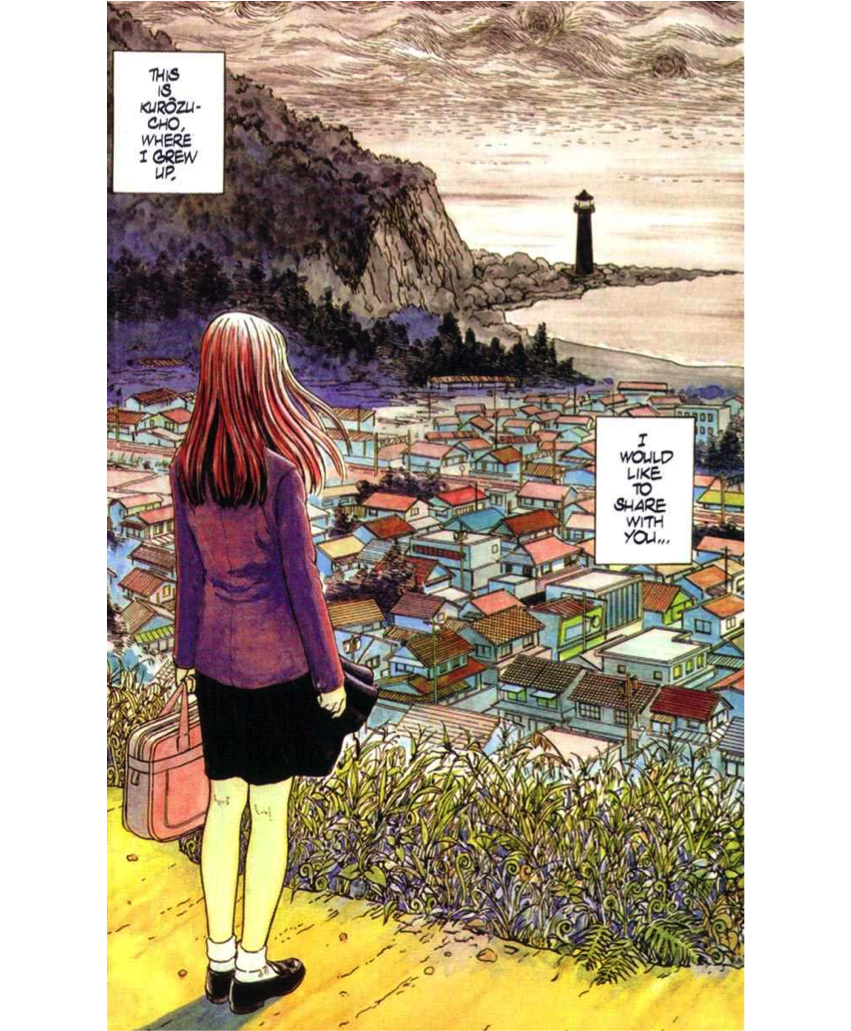
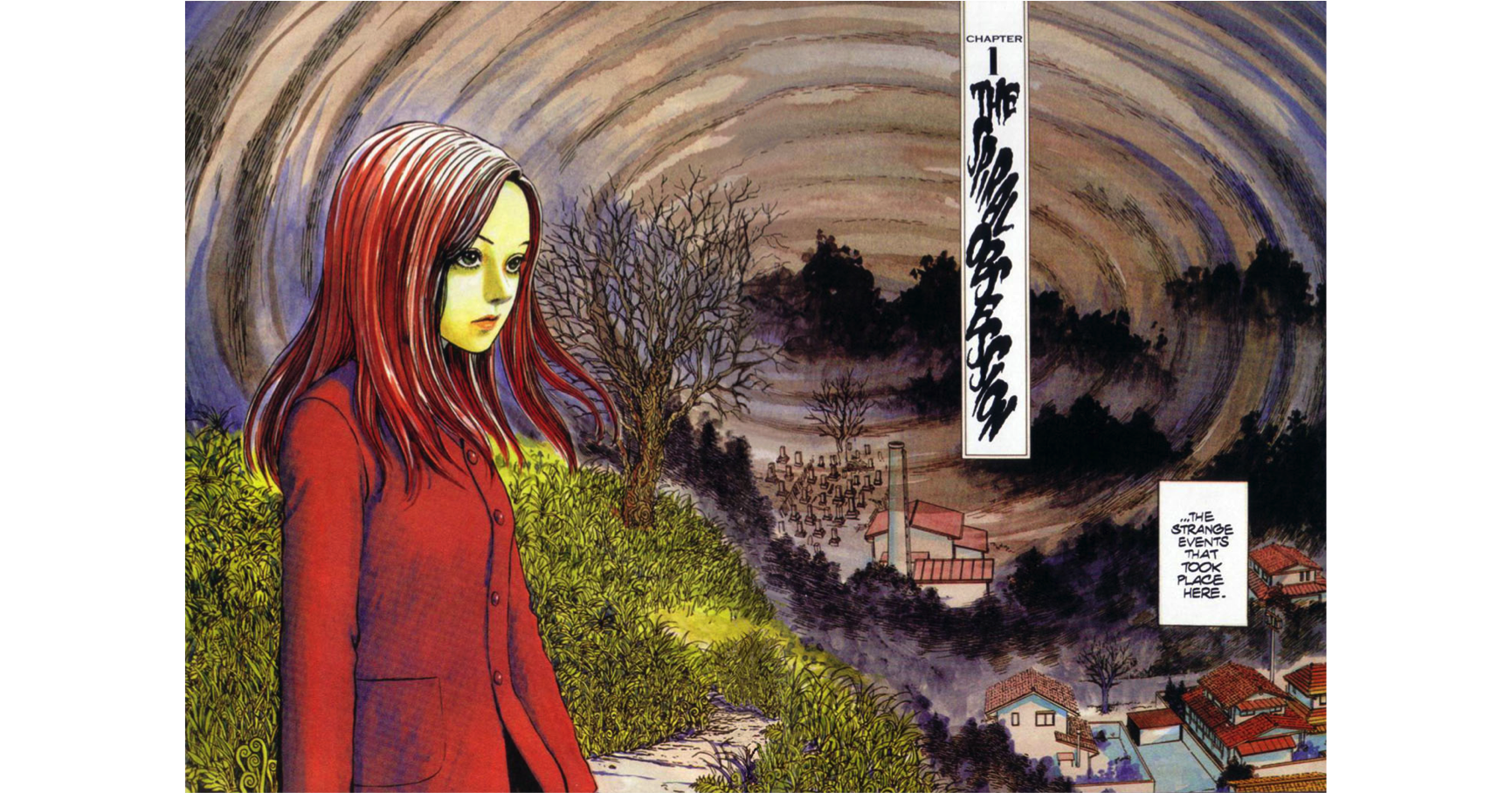
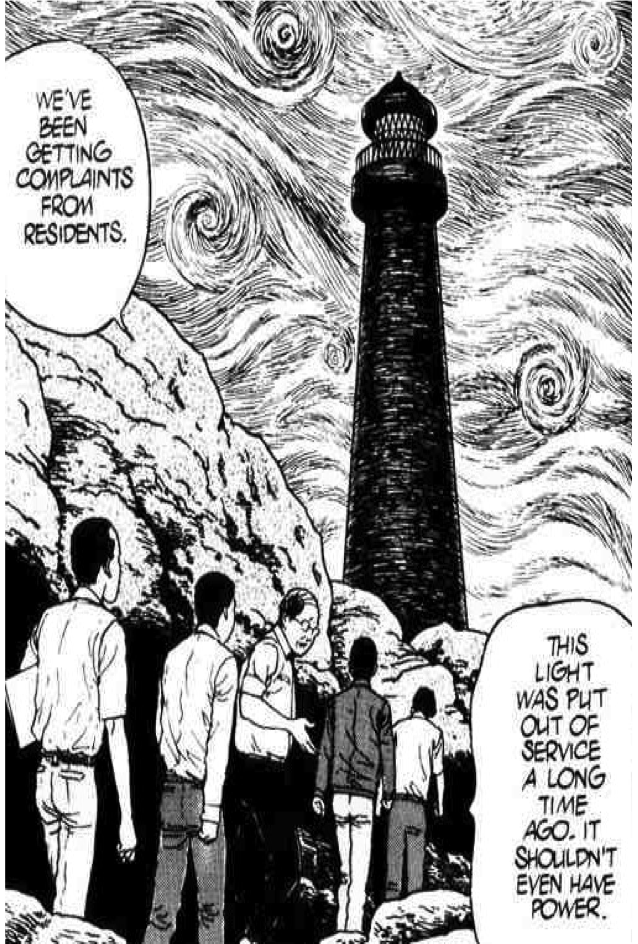
Uzumaki proper opens very differently, with an establishing full-bleed splash: Kirie stands atop a hill, her back to the reader, looking out over the town and toward a misty grey sea, distant black lighthouse and scuttling clouds.

Untitled

Junj Ito, Uzumaki, trans. Yuji Oniki (San Francisco: VIZ Media, 2010)

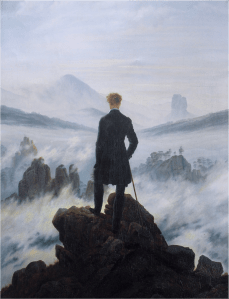
This composition is in many ways a traditional Rückenfigur, echoing a painting long associated with Romantic sublimity, Kaspar David Friedrich’s “Wanderer Above a Sea of Fog” (1818).

Untitled

Kaspar David Friedrich’s “Wanderer Above a Sea of Fog” (1818).

Friedrich’s painting puts viewers in the position of witnessing the encounter between human subject and sublime landscape, inviting them to revel in this figure’s mastery of nature. The Wanderer’s position conceals his face, universalizing the encounter between spectator and spectacle while inviting disinterested reflection by preventing the emotional contagion of a facial close-up. An elevated, masculine figure, Friedrich’s Wanderer is an emblem for the mastery of nature by a transcendental aspect of human subjectivity, whether it is understood to be sensibility (as in Ann Radcliffe’s novels) or moral reason and a sensus communis (as in the Kantian version of the sublime encounter.)

The Wanderer’s placement is paralleled by Kirie’s, but with a number of significant differences. Where the Wanderer’s stance bespeaks strength and mastery, his arms cocked confidently as he leans on his cane, Kirie’s bespeaks apprehension and vulnerability. One hand clenches the handle of a schoolbag, its pinkish colour linking it to the roofs of the tidy houses below; her feet, close together, point directly toward the gathering storm visible on the horizon, the line of her narrow shadow stretching behind her, suggesting her inexorable movement toward it. Subtly, this signals the agency of the spiral itself, an agency to which Kirie and the other human characters can only passively respond. Kirie’s other hand hangs half-curled at her side in a nervous clench, index finger slightly open, as though she is about to point the storm out to the viewer who lurks, unseen, behind her. Where the Wanderer surmounts his environment and is fully centred, Kirie is offset. Despite her elevated vantage above the town and sea, she is askew, displaced. Where the Wanderer seems implacable, Kirie is buffeted by unseen powers.

The horizon, fog and wind in Friedrich’s painting are soft, nebulous, edgeless in contrast to the Wanderer, who is as solid as the indomitable rocky promontory on which he stands; contrastively, the dark density of the lighthouse in Ito’s image draws both Kirie and the reader’s eyes, underlining the stormy sky’s surge of black lines. In three places, these lines converge into whirlwinds. These whorls are echoed by a series of tiny spiralling plants emerging from the clutch of wild grasses visible between Kirie and the town. These green fuses appear innocuous here, but their presence on this page crucially distinguishes its introduction of speiromorphism from that in “Galaxies” by portraying it not as an extra-planetary, alien force, but as an elemental principle, already diffusely present in the earth and its diverse life.

Untitled

Junj Ito, Uzumaki, trans. Yuji Oniki (San Francisco: VIZ Media, 2010)

When readers turn to the second page, the small spirals on the opening splash are supplanted by a single, brush-stroked, vaporous spiral, extending to the edges of the full-bleed two-page spread that follows.  Kirie’s apprehensive face stares off the facing page, where presumably the clouds still swirl ominously. Opposite her, beneath the line of her gaze, past the grass, more of which now coils, the town sprawls. Friedrich created space for disinterested contemplation by putting the Wanderer between viewer and landscape and excluding his face from the image. While this effect is echoed by Uzumaki’s opening page, it is shattered here, as the reader comes face-to-face with Kirie’s wide-eyed visage. It is a jarring transition, especially because the swerve of perspective that produces it means readers have executed a spiral in relation to Kirie’s position, curving ahead of and moving menacingly toward her.

From its outset, Uzumaki uses its visual style and structure to aggressively undermine the privileging of the human figure in images informed by Romantic capitulations of the sublime encounter. It also subtly sutures the reader’s perspective, but not to Kirie (as the more traditionally structured “Galaxies” does). In these opening pages, we are invited to watch Kirie, rather than identify with her, while our perspective is sutured instead to the invasive swerves of the spiral. Thus Ito visually realizes Lovecraft’s dictum that the “true ‘hero’” in weird fiction is a “set of phenomena”:

“Individuals and their fortunes within natural law move me very little. They are all momentary trifles bound from a common nothingness toward another common nothingness. Only the cosmic framework itself—or such individuals as symbolize principles (or defiances of principles) of the cosmic framework—can gain a deep grip on my imagination and set it to work creating. In other words, the only “heroes” I can write about are phenomena.”

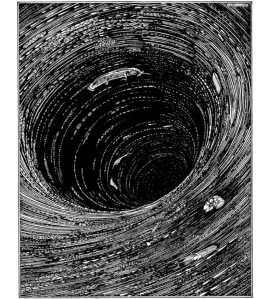
While its presentation varies widely from episode to episode, the phenomenon at Uzumaki’s core is, effectively, the idea that under a certain set of unexplained conditions, at certain times, every object and entity in the vicinity of Kurozo-Cho becomes subject to a perverse version of fluid mechanics, spontaneously beginning a gradual transition from a laminar to a turbulent flow regime, assuming the form of a vortex or eddying whirl. This transition is signalled by Ito’s visual references to Harry Clarke’s illustration of Poe’s “A Descent into the Maelstrom”:

Untitled

Clarke’s 1919 illustration for Poe’s tale

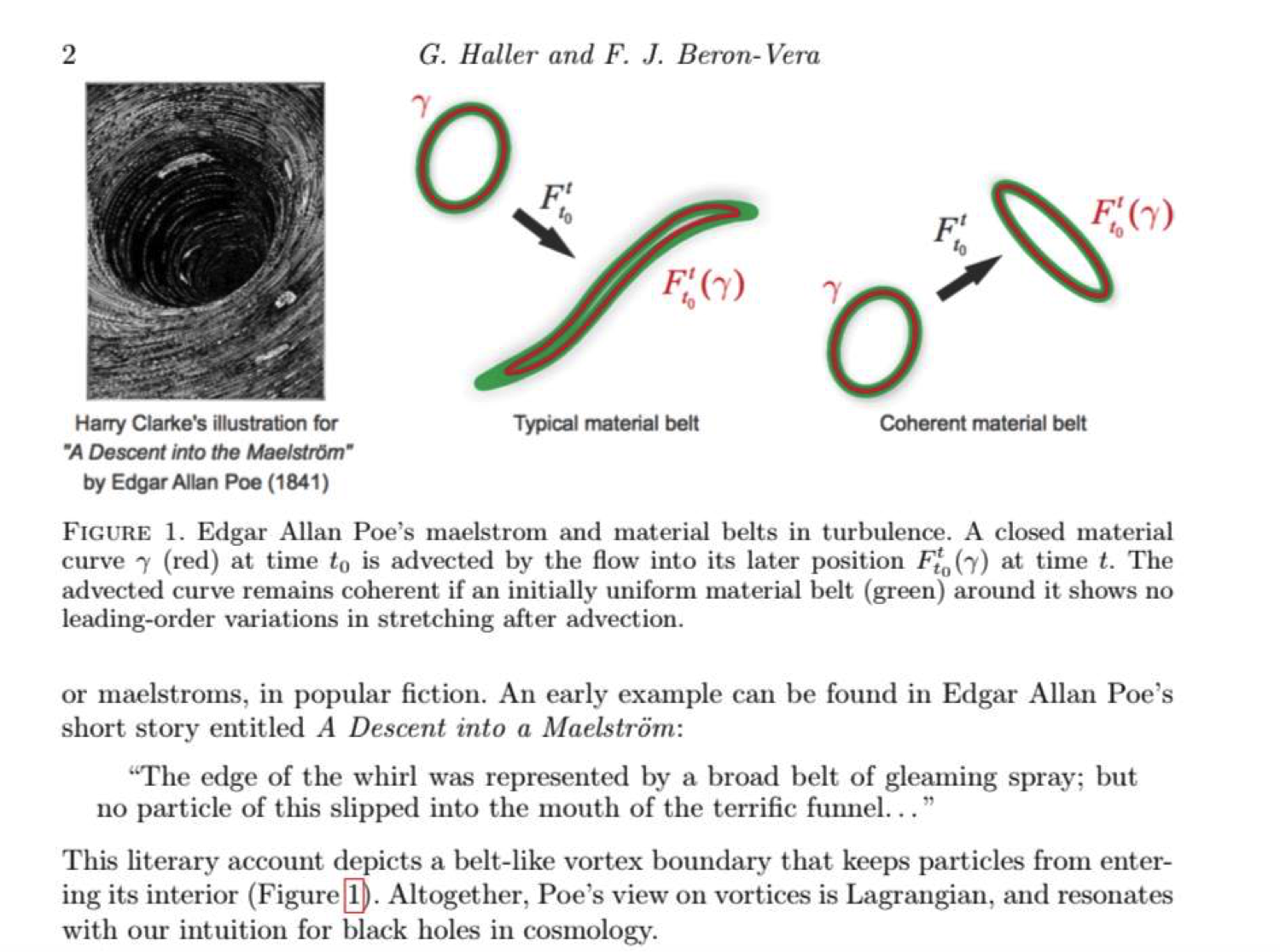
Poe’s description of the marine vortex in “Maelstrom,” deeply influenced by his interest in 19th century mathematics and astronomy, has been held up by some physicists as uncannily anticipating contemporary research into the dynamics of marine and astronomical vortices, leading some contemporary physicists to use it as verbal demonstration of the mechanics of a Lagrangian vortex, arguing that it “resonates with our intuition for black holes in cosmology.”Untitled

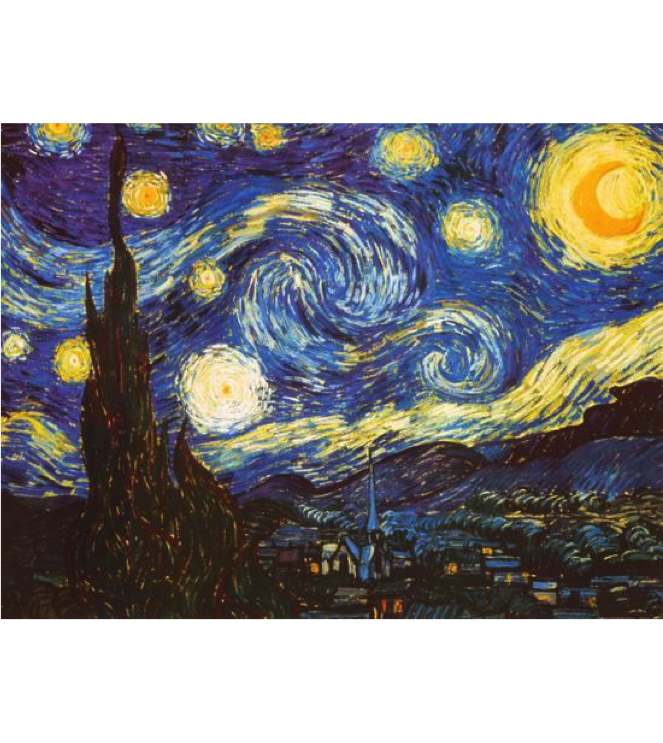
The whirled horizon on Uzumaki’s opening page also suggests a second visual parallel, this time to Van Gogh’s “Starry Night.” This parallel becomes more evident as Uzumaki unfolds.

Untitled

Vincent Van Gogh, “The Starry Night,” 1889.

In Uzumaki’s opening splash, the too-close vertical shape of the poplar trees in “Starry Night” is paralleled by Kirie’s figure, and where the emerging spire of a church punctures Van Gogh’s town, it is the distant, but darkly prominent, image of the lighthouse that punctures Ito’s.

Later in Uzumaki, the lighthouse assumes the position of Van Gogh’s poplars, uncannily underlining the unruly animation of an architectural object that is itself subject to seemingly undirected, turbulent transformation. Ito and Lovecraft’s shared fascination for vortices also accounts for Uzumaki’s many visual allusions to Van Gogh’s paintings, which have fascinated modern physicists by their detailed visual representations of turbulent flow.

Untitled

Junj Ito, Uzumaki, trans. Yuji Oniki (San Francisco: VIZ Media, 2010) a caption


Ito excels at creating awe-inspiring and horrifying effects through his curvilinear visual designs and narrative structure. His detailed, dynamic depictions of turbulent matter lend a realism to Uzumaki that make a suspension of disbelief possible even during its most outré episodes. His line-work serves a purpose similar to the gradual accumulation of physical detail that shores up Lovecraft’s greatest works of mature cosmic horror, “At the Mountains of Madness,” The Colour out of Space,” and “The Shadow Out of Time.”

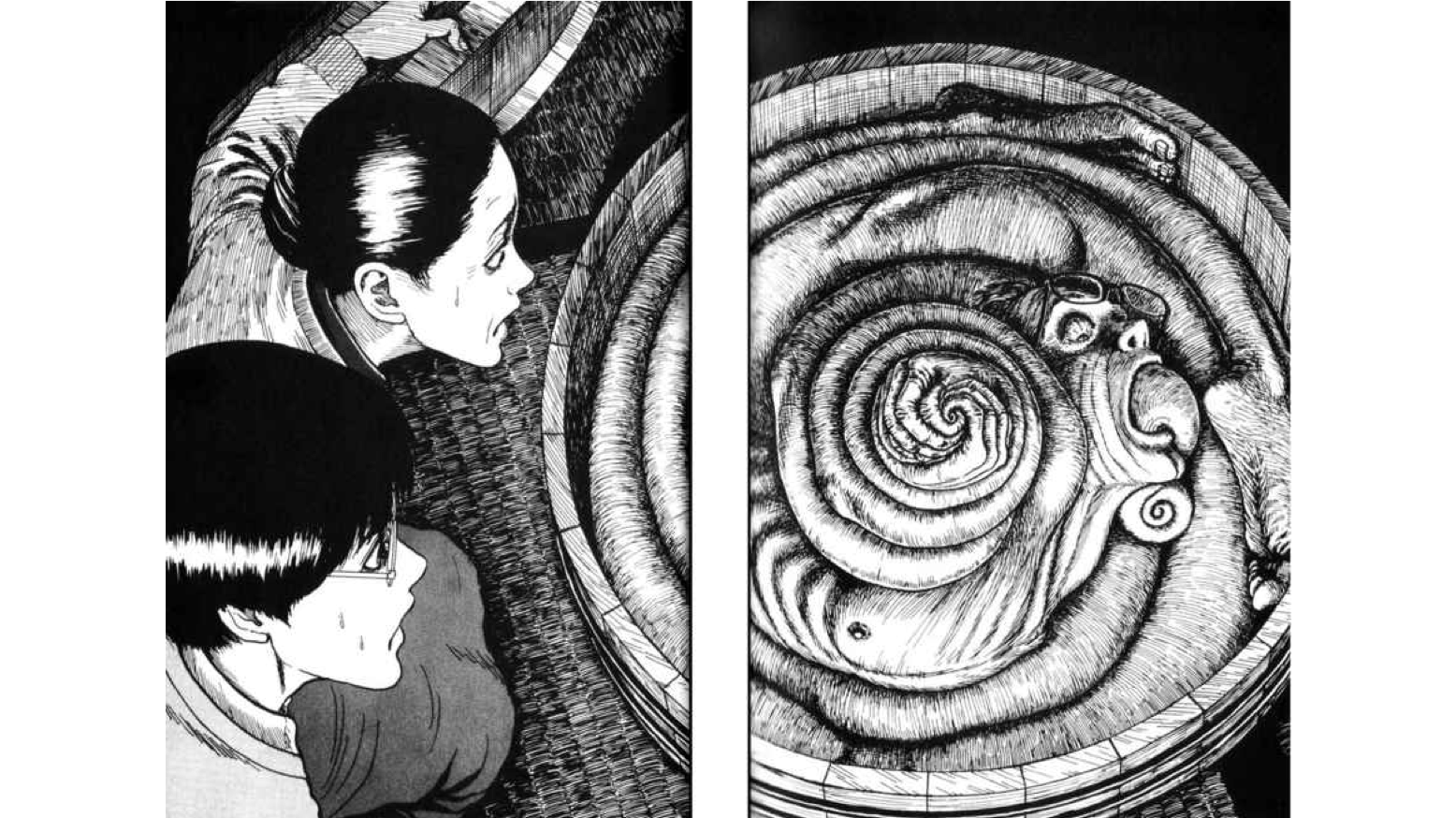
Ito’s vortical techniques create unforgettably inventive grotesques. Their cumulative effect is a distortion, and eventually an erasure, of the human figure, one first made explicit by the fate of Shuichi’s father:

Picture1

You and me…. or proto-maki? Junj Ito, Uzumaki, trans. Yuji Oniki (San Francisco: VIZ Media, 2010)

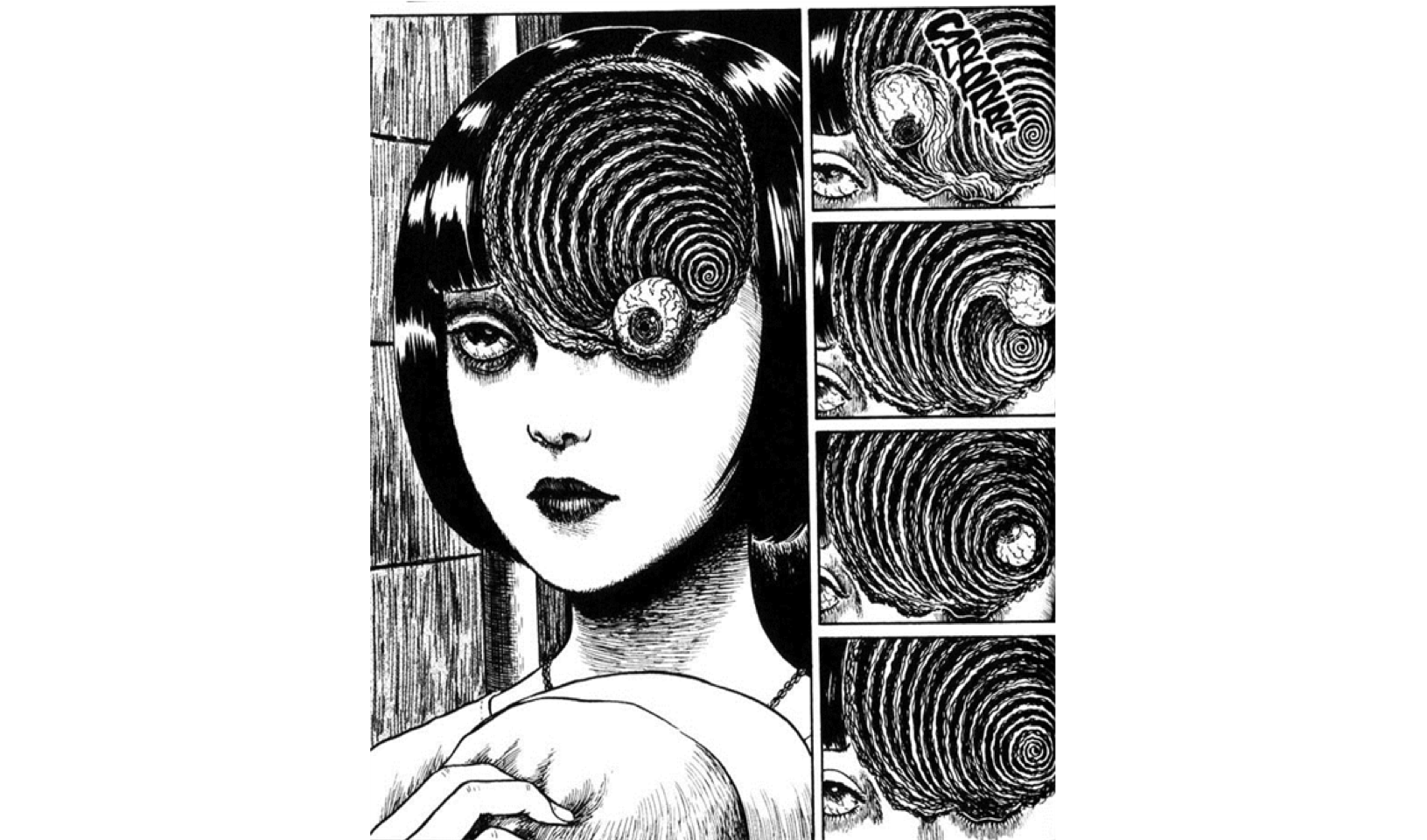
Uzumaki‘s third chapter introduces Azami, a new student at Kirie’s school. A visual echo of Ito’s earlier manga character Tomie, Azami has a small crescent-shaped scar on her forehead, which she claims typically makes her irresistibly attractive. Under Uzumaki’s turbulent regime, however, the scar rapidly transmutes from a charming crescent into a spiral, continually increasing its dimensions by drawing more and more material into its involutions, absorbing first the majority of Azami’s face, and then objects and characters in her vicinity.

During this episode, a series of panels focused on Azami’s face forces readers to follow the course her eye takes as it spirals into the vortex most of her visage has become, finally receding into the depths of the panel and disappearing. By forcing readers to follow Azami’s displaced eye down a vortex into subliminal oblivion, this page provides a disturbing metonymy of Uzumaki’s suturing of the reader’s gaze to spirality itself:

Picture1

Junj Ito, Uzumaki, trans. Yuji Oniki (San Francisco: VIZ Media, 2010)

Uzumaki uses its weird regime of turbulent flow to birth numerous grotesques, torquing human forms over and over again into spiral mutations in a relentless visual erasure of the anthropic that is, arguably at least, more “Lovecraftian” than anything Uncle Theobald himself ever wrote.

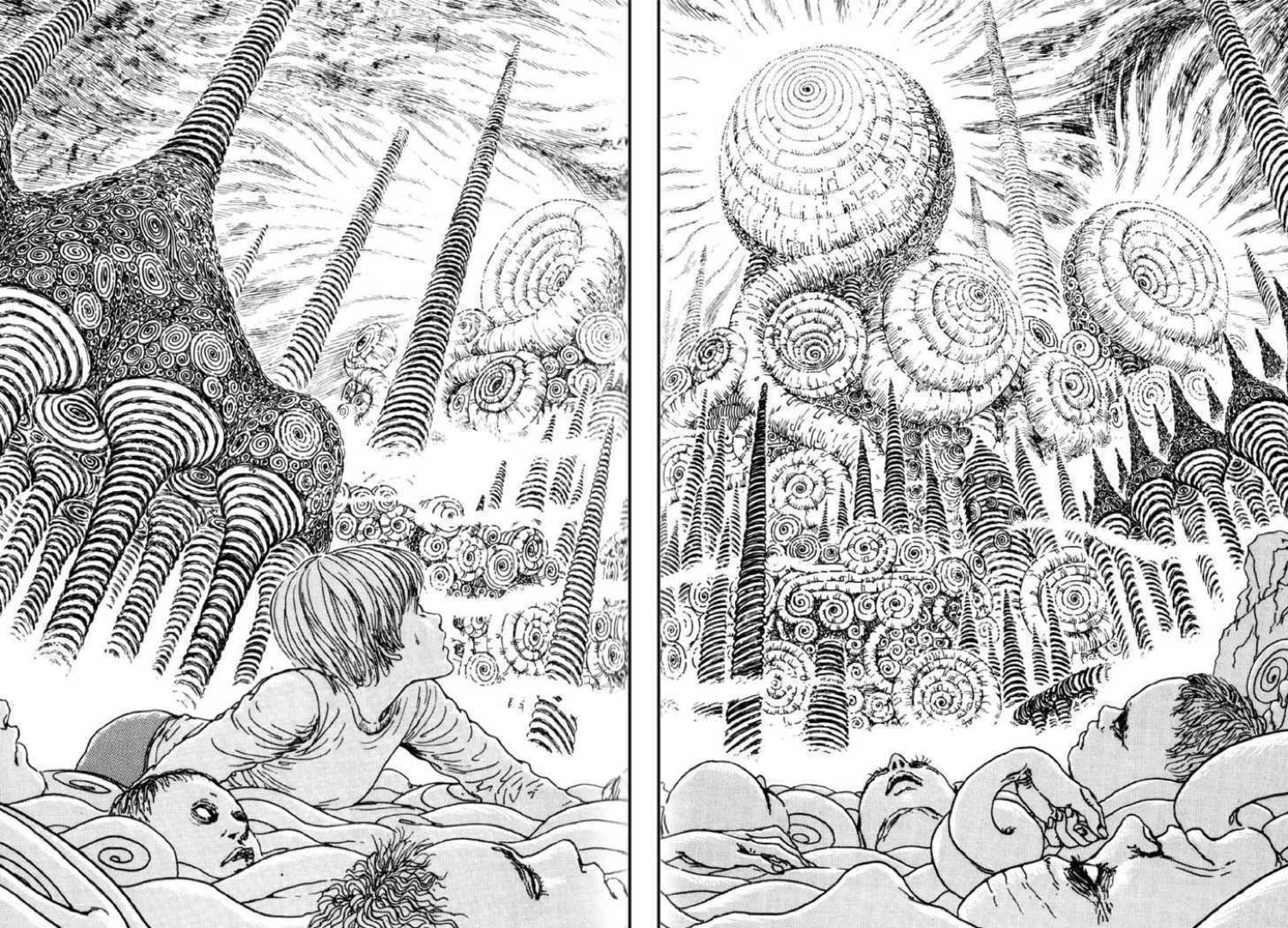
The manga is at its most Lovecraftian during Kirie and Shuichi’s descent into the subterranean mega-spiral structures that turn  below the transfigured town. This brief procession of panels in particular echoes the “palaeogean megalopolis” discovered by Danforth, Dyer and co. in At the Mountains of Madness.

Picture1

Junj Ito, Uzumaki, trans. Yuji Oniki (San Francisco: VIZ Media, 2010)

Appropriately enough, it is in Mountains that the tension between the spiral as chaotic emblem of undirected mutation and the spiral as emblem of harmonious order becomes most evident.  Here, the admirable (for HPL, in any case) civilization of the Elder Things is embodied in their architectural art, oriented around a “spiral band of heroic proportions,” while the revolting, destructive power of the shoggoth is likewise figured by the spiral waves of force that surge before its protoplasmic bulk.

Ultimately, however, Ito draws his readers into cosmic horror with a rather unLovecraftian comical twist. Much as “Galaxies” humorously subverts the lofty aspirations of the cosmic sublime, Uzumaki romantically subverts Lovecraft’s grimdarkest reaches with a dark grin.

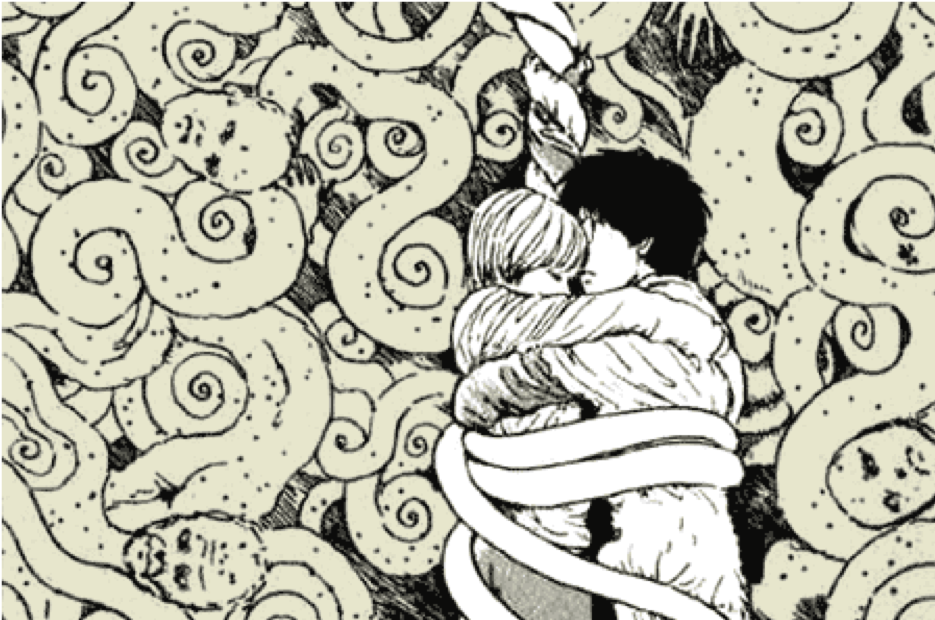
Its final, and strangely sweet, visualization of speiranthropy occurs with the culmination of Kirie and Shuichi’s star-crossed romance. The beset teens finally share an embrace that leads to their coiling around one another in a serpentine double-helical structure. In these panels, speiranthrôpos marries the microcosmic spirals of DNA to the macrocosmic mega-spiral that absorbs the entire town into its unity on the pages that follow. 

Picture1


This is the last glimpse Uzumaki offers readers of an anthropic form. The remaining panels provide interior images of the mega-spiral’s self-completion as vast, conjoined symmetrical speiromorphs interlink and twist. The panel borders fragment these massive forms, a Piranesian effect that amplifies their alien majesty. The relationship between panel-to-panel movement and narrative time is ambiguated; there is no narration, the images overlaid instead by sibilant, inhuman onomatopoeia that intersects the images it overlays in a disorienting, and literally posthuman, montage.

Until the reader turns to the last page, that is… But that’s another conversation.


Tagged , , , , , , , , , , , , ,

THE LIFE AND AFTERLIFE OF HORROR FICTION by John Glover

texas_chainsaw_massacre_1_poster_01-texas-chainsaw-massacre-the-evil-dead-10-horrors-to-watch-this-halloween-jpeg-164992

In the world of horror fiction, through the booms and busts, writer, scholar and librarian John Glover meditates on a perennial question….

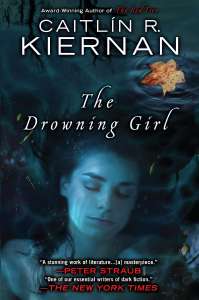
The idea that publication of horror fiction follows boom and bust cycles is common among the people who make up the field, from writers to readers, from publishers to critics. It’s easy to understand why this view persists, given the rise and fall of the Gothic, the penny dreadful, the pulps, and the horror boom that lasted roughly from 1970 to 1995. Readers and aficionados of the genre are accustomed to saying that all of the above are the same thing, just wearing different masks. While this is true in the sense that similar subject matter and tropes recur through the decades, increasingly I’m coming to question whether horror will survive as a formulation for the literature that most of us recognize under that name, whether Dracula, Psycho, or The Drowning Girl.

Drowning_Girl_book_cover

Caitlin R. Kiernan has long contested the value of the term “horror” as a generic label.


If it weren’t for the rise of the web and its capacity to perpetuate both communities and content, the term “horror” would largely have fallen out of use by now to describe the genre. As things stand, however, I feel that we’re currently in the middle of two waves of fiction that could rightly be called “horror,” each as similar and distinct as the Gothic and the pulps. One of these waves is essentially the long tail of the last boom, and the other is a new formation built from literary fiction, a new attention to sociocultural concerns, and explicit engagement with the genre’s history. The coexistence of these two waves has caused anxiety in the field, not least because the word “horror” itself became anathema after the market crash of the mid-1990s. Many authors working today take a nuanced approach to writing horror—heavily informed by the lessons of the boom.

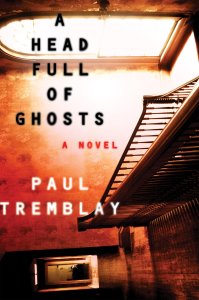
One of 2015’s most successful horror novels was, on many counts, Paul Tremblay’s A Head Full of Ghosts. This elegant tour de force is graced with both literary style and genuine unease, revolving around a case of suspected possession and a family forced to turn their lives into a media spectacle in the hope of saving their daughter. It quite clearly belongs to horror, drawing on such sources as The Exorcist and the reflexive frights of Scream, featuring a narrative self-awareness based out of reality television and social media that can stand comfortably with literary conceits stretching back through the history of narrative. The fabric of the book is woven from after-action discussions between the protagonist and her literary documentarian, and blog posts analyzing the abortive documentary filmed during the events around which the novel centers. The novel shifts easily back and forth between exposition, recollection, and introspection. These many layers are critical to the book’s success, and leading it to be described in one review as “smartly, viscerally [exposing] the way mass media, the Internet and pop culture have transformed our experience of that primal human impulse, horror” (Heller).

head_full_of_ghosts

How else can we tell that A Head Full of Ghosts is a horror novel? As of this writing it is a candidate for a Stoker Award from the Horror Writers Association, for Superior Achievement in a Novel. Users of the social reading website Goodreads identified the novel as “horror” more frequently than any other genre. Finally, none other than Stephen King said that it “scared the living hell out of me, and I’m pretty hard to scare.” Awards, readership, and influential voices all indicate that this novel belongs to the horror field.

All of that said, A Head Full of Ghosts was published by William Morrow, a HarperCollins literary imprint. While this high-visibility publication has been cause for celebration among horror writers who aspire to broadly successful authorial careers, HarperCollins has avoided the H-word in describing it (though the imprint does in fact publish works it categorizes as horror). What does it mean for a novel to succeed in a genre to which its publisher does not necessarily feel it belongs? Tremblay himself has diverse interests and a genial social media presence that connects with longtime horror authors and professionals… as well as musicians, educators, literary authors, and all manner of people involved in the book trade. He does not seem to me to resemble the bulk of authors prominent during the boom, who in profiles and interviews were likely to cite a narrower set of influences and interests: Bram Stoker, H.P. Lovecraft, Richard Matheson, and so on.

Authors continually remix literary genres, of course, and genres go in and out of fashion, but both Tremblay and his Head Full of Ghosts exist in two (or more) separate spheres of horror. A quarter century after the boom, one might expect to see a resurgence of horror in a new generic formation. That has happened in the guise of things like “zombie fiction,” and a healthy stripe of dark YA, and horror novels that fly under different colors for any number of reasons, but it has also not happened, insofar as substantial numbers of people still read, write, and talk about “horror.” Here I will leave Paul Tremblay as case study, but it seems worth saying that he has good company in the sundry contemporary authors who exist in a state not entirely unlike that of Schrödinger’s Cat, being both horror authors and not-horror authors.

If there’s something distinctive about the horror genre, starting around 1970 and ending in the mid-1990s, it seems useful to discuss that time frame. Various books have been associated with the start of the boom: Rosemary’s Baby in 1967, The Exorcist in 1971, Carrie in 1974. All make reasonable candidates for signposts, and certainly there was a market for short horror fiction at the time, including men’s magazines and fantasy and science fiction publications that occasionally published horror.

What is somewhat harder to pin down is precisely when the idea of a “horror author” or “horror writer” emerged. While many authors wrote horror stories of one kind or another prior to 1970, the concept of an author who was segregated from others by the adjective was not common. I’m not going to say that no one called herself a horror writer prior to any particular date, as that would require exhaustive searching to prove a fairly small point. I do think it’s notable, however, that the MLA International Bibliography, WorldCat, and Google Books include virtually no mention of a “horror writer” or “horror author” prior to 1960, and barely any prior to 1970. None of those sources are without their problems, but for all that we have supposedly always had horror fiction, it’s interesting to me that we have not always had horror authors. Not until the late 1970s and 1980s do we really see the idea gain traction, coinciding with the rise of postmodernity in the U.S., the consequent broadening of the canon, and the mass market success of horror fiction.

The end of the boom has been discussed by countless writers, editors, and anthologists, from the end of Zebra Books to the glut of vampire fiction, and I see no need to cover it again here. Scholarly work in this area, however, has been limited. The best study thus far published about the horror boom as a phenomenon unto itself is Steffen Hantke’s 2008 article about Dell’s Abyss imprint and the decline of literary horror in the 1990s. By focusing his work on an imprint exceptional in its time, publishing substantial numbers of female horror authors who wrote in anything but demotic style, Hantke anticipates concerns and disputes that have taken on greater resonance than ever in recent years (64).

In an essay based on a speech he delivered at the 1998 Horror Writers Association Bram Stoker Awards Banquet, Douglas E. Winter discussed at length the rise and fall of the category of “horror” publishing, and how such authors as William Peter Blatty or Jack Williamson did not write books that went under that name. He called this kind of writing “a progressive form of fiction, one that evolves to meet the fears and anxieties of its times,” and claimed that “[w]hat we are witnessing, then, is not the ‘death of horror,’ but the death of a short-lived marketing construct that, although it wore the name of “horror,” represented but a sideshow in the history of the literature” (Winter).

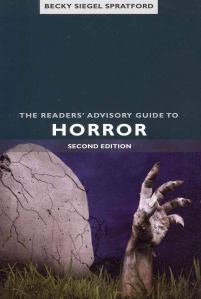
Can we really call “short-lived” a period of vigorous literary productivity that lasted at least a quarter of a century? I don’t think so, and I think it becomes more problematic if you start from the position that there are meaningful differences between Gothics, Victorian ghost stories, pulps, the mid-century fiction of Richard Matheson and Shirley Jackson, and so on. To say that it’s “all horror” makes some sense to me as a reader, because it’s what I personally seek out, and this is supported on some level by books like Becky Siegel Spratford’s The Readers’ Advisory Guide to Horror, one of a class of tools designed to help librarians understand genres and make recommendations for library patrons looking for something to read. The same is true of surveys of the genre like Gina Wisker’s Horror Fiction, which seek less to parse out than to provide a rich overview of the full progression of the literature of fear in its different phases. Useful rubrics for broad understanding or guides for literary taste, however, will not necessarily provide the best guide for periodization.Spratford

A significant turning point in the horror boom was the formation of a professional organization devoted to writing horror. The Horror Writers Association met for the first time in 1985, spurred by a sense of shared interests and a need for a professional organization, among other things. The story of its founding, originally as the Horror and Occult Writers League, has been documented many places, but the timing generally seems to come in for little discussion (perhaps a mercy, given what was to follow). Not many years after the field started taking on the trappings of other popular genres like fantasy and science fiction, romance, and mystery, the market started to wane. It didn’t happen overnight, and it didn’t happen totally, but this newly organized group of professionals was to some extent deprived of their newly catalyzed profession. Notables like Ellen Datlow, Stephen King, Anne Rice, or Peter Straub were able to persevere, but countless others changed genres, switched to other kinds of writing, or left the field.

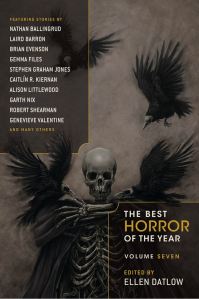
What happened after that was predictable in some ways, less so in others. Writers who wanted to write fear-inducing fiction found other niches where they could do that. Sometimes that meant small press and markets paying well below professional rates, if they were free to write at that level or driven to it by their own natures. Others found welcome audiences in other genres for darker spins on the thriller or fantasy novel. Small presses variously endured, failed, or appeared, and the last decade has seen a surge in new markets for dark fiction. The Stoker Awards given by the HWA did not vanish with the mass market, and neither did World Horror conventions. Ellen Datlow and Terri Windling, who in 1988 launched their summative anthology series, The Year’s Best Fantasy and Horror, did not call a halt when the field was in a down-swing. Datlow currently edits The Best Horror of the Year, a summative anthology that she launched solo in 2009 after the final volume of Year’s Best Fantasy and Horror, and her work has been joined over the years by similar volumes focusing on horror, dark fantasy, weird fiction, and so on.

ybh7-cover

What also happened after the boom was that many of the people who were part of it, both the professionals and the readers, stayed together in various ways. Some of that resembled historical activities of fans in other genres, such as fanzines and letter-writing, but some of it was not as readily possible after previous literary markets waned. Many members of the horror community stayed connected online via Usenet, chat rooms, message boards, blogging platforms, and all of the social media that have come since. Even with the most powerful signifier of the time, the word “horror,” largely erased from the market, it was possible for the people of horror to stick together as never before. This reaffirmed the existence of both their community and the horror field, even when that field at times looked very sparse.

Earlier I claimed that there are two separate waves of horror fiction ongoing today. The more recent one is characterized by authors like Laird Barron, Stephen Graham Jones, Caitlín R. Kiernan, John Langan, Livia Llewellyn, Nick Mamatas, Helen Marshall, Simon Strantzas, or Paul Tremblay. These authors have by and large been heavily influenced by mainstream literary or academic writing cultures, are socio-politically aware in ways that carry over to their fiction, business practices, or both, and occasionally write metafictional or otherwise highly reflexive stories that engage with the genre’s history.

The other wave, the long tail of the boom, is visible in many places. Publishers like Centipede, Subterranean, and Valancourt are reissuing work from the boom, sometimes in revised or expanded versions. In other cases they are releasing sequels to or alternate versions of decade-old horror novels that have enough of a potential readership that publishers can afford to invest in sometimes lavish editions. Even allowing for the vagaries of memory and searching on the Web, it is easier than in decades past to dive into the memorabilia, fan reports, photographs, and retrospectives associated with the boom. This sustaining of the aesthetic of the boom undoubtedly has fed into the success of any number of recent publications, from presses large and small or authors who self-publish.

Is this a genuine continuation of the boom, or just an outsized case of nostalgia? I’m not sure, but there is a wider range of awards for the horror field these days, and it often seems like significantly different groups of authors and kinds of fiction are associated with different gatherings, whether it be World Horror, Readercon, NecronomiCon, or Necon. In future, I would like to examine more thoroughly the awards, nominees, and guests at such events, and attempt to map the different spheres of the genre, associated with the boom or otherwise.

In a nice irony, the thriving Nightmare Magazine regularly runs a column entitled The H-Word. It consistently features thoughtful commentary from authors across the spectrum of horror. Explicit engagement by professionals writing today under a column bearing a title that was at one point a joke is perhaps indicative of the field’s ability to cope with an ongoing state of flux better than during past publishing cycles.

Where does that leave us? On the one hand, it’s easy to locate published fiction that rests comfortably cheek by jowl with the horror of the boom, whether in anthologies, magazines, or novels. On the other, it’s also easy to locate anthologies, magazines, or novels that partake of horror while eschewing the H-word, whether as prominent as a novel like A Head Full of Ghosts or otherwise. The rise of transmedia spectacles like The Walking Dead lies in this camp to some extent, insofar as one can spend hours trawling through reviews and critical articles describing it as “dark drama” or the like, before getting to anything that will call it without adjective or concession simply “horror.” Whether this reflects actual animus against horror is difficult to say, but it does confirm that some people perceive one term as significantly more useful than another, decades after the boom.

If my portrayal of this situation of two ongoing waves of horror fiction is accurate, are they going to end? Can we still talk at this point about the cyclical nature of the field, in a world where micro-presses, boutique presses, Kindle, and other means can keep a genre rolling along in some capacity as long as there are customers ready to buy? It may be that we are not, as many have argued, in any sort of golden age or temporary efflorescence, but have actually entered something like a steady state where nothing ever dies.

If I were to point to a marker indicating anything like relative ill health in horror fiction, I might point to changes in the scholarship. A recent Call for Papers that went out on academic discussion lists for a “monster studies” conference session did not use the word horror at all. Likewise, the Horror Literature section of the International Association for the Fantastic in the Arts is smaller than it used to be, partly because some members of the association choose to talk in other genre contexts about subject matter that many have seen as belonging to horror. The existence of scholarship is, of course, not a precondition for the existence of the fiction it treats, but it is part of the swirl of the literary ecosystem—reviews, criticism, fandoms, and so on—that reflects the life of fiction once it has left the bookstore or library.

In 2015 I attended the World Horror Convention, still one of the major gatherings for professionals in the field. Panel discussions were vigorous, energetic, and spoke to ongoing engagement with horror and serious questions about what horror is or is not, should be or should not be. This gathering seems to me to be in relatively good health, although the impact of this year’s division of the event into an awards weekend in Atlanta and a convention in Las Vegas, held within days of each other, is yet to be seen.

On the other hand, I recently ended a two year term on the Board of Directors of James River Writers, a thriving literary organization based in central Virginia. In that time, never once did I hear attendees discuss horror fiction at our events, which include a sizeable annual conference that actively works to accommodate writers of YA, erotica, romance, other genres not always welcome in “serious” literary circles. On those occasions when I talked with members of the organization or visitors about what I write, the conversational ground inevitably became shaky the moment I trotted out the H-word. In the most memorable of these interactions, the woman I was speaking with said that her daughter liked Twilight and vampire books. I said that I could appreciate that, because I wrote horror. She hesitated for a long time, but eventually she said that she didn’t usually think about people writing horror, and that you usually thought about horror movies. While this conversation may simply reflect lack of awareness, it suggests to me the possibility that for some people, from experienced readers to novice authors, the subject matter of horror exists, but not necessarily a living genre entirely devoted to ghosts, zombies, vampires, werewolves, serial killers, haunted houses, the occult, and so on.

At the end of the day, I’m not suggesting that we should attempt to rename the genre or the study of its literature. I do, however, think that we should be cognizant of the extent to which the horror boom shaped the way that we consider, write, and write about horror fiction. While I am not prepared to say that M.R. James, H.P. Lovecraft, or Shirley Jackson did not write horror fiction, I am coming to believe that it’s anachronistic to talk about any of them as being horror writers. Our tendency to do so is a byproduct of our own moment in the history of the literature of fear.

Acknowledgments

I presented an earlier version of this at ICFA 37 as “Anxiety, Nomenclature, and Epistemology after the Horror Boom,” where the audience had many helpful comments and useful queries. I am grateful for criticism from Lindsay Chudzik, Mark Meier, and Sean Moreland, all of which helped to strengthen the work, and to s.j. bagley for many thought-provoking conversations about the boom. Finally, I am grateful for the support of my employer, VCU Libraries, in pursuing my scholarly interests.

ThinkingHorror

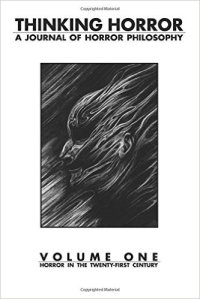
Thinking Horror, volume 1, edited by s.j. bagley and Simon Strantzas


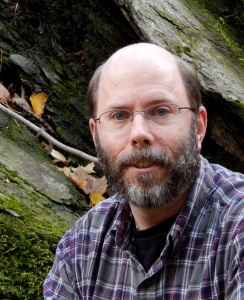
John Glover is a librarian at Virginia Commonwealth University, where he supports humanities research and instruction, contributes to various digital humanities projects, and studies quaint and curious volumes of forgotten lore. He has chapters forthcoming on Supernatural Horror in Literature and Laird Barron’s Old Leech stories. He also studies the research practices of writers, and last year he co-taught “Writing Researched Fiction” in VCU’s Department of English. He publishes fiction and literary essays as “J. T. Glover,” and his work has appeared or is forthcoming in Pseudopod, Thinking Horror, The Lovecraft eZine, and Nightscript, among other venues.

jtglover-author-photo

John (aka J.T.) Glover

Tagged , , , , , , , ,