Tag Archives: gothic fiction

“From the Eternal Sea He Rises”: Re-Reading the Political Theology of Antichrist through Lord of the World (1907) and The Omen (1976)

Or, some thoughts on how R.F. Benson’s novel serves as an interpretive supplement to Catholic antichrist discourse much as The Omen serves as an unofficial spectacular supplement to evangelical dispensationalism and apocalyptic Christian Zionism

By Sean Moreland, PhD

This post is based on a conference paper I presented at the 2nd biannual conference of the Society for the Study of the American Gothic, Salem, MA, March 2026. It was part of a panel commemorating the 50th anniversary of The Omen organized by my esteemed colleague-in-gothic-and-monster-studies, Regina Hansen.

Hansen’s presentation was developed into her contribution for a special issue of the fabulous digital open-access monster studies journal Monstrum, “The Omen at 50: Reflections on a Horror Franchise.”

The essays included in that issue each offer fascinating and highly disparate perspectives on the film’s achievement and legacy, and you can read them online, gratis, here.

“When the Jews return to Zion
And a comet rips the sky
And the Holy Roman Empire rises,
Then You and I must die.

From the eternal sea he rises,
Creating armies on either shore,
Turning man against his brother
‘Til man exists no more.”

So goes the prophetic poem Catholic priest-turned-Satanist-reborn-Catholic-after-Pauline-Christophany Fr. Brennan (Patrick Troughton) recites to Robert Thorn (Gregory Peck), notifying him of the crucial role Biblical prophecy has assigned his crypto-adopted son Damien Thorn (Harvey Spencer Stevens) in Richard Donner’s classic film The Omen (1976.) The scene in which Brennan delivers this poem, with its masterful tension and powerful performances, has often been singled out by viewers as one of the film’s most unforgettable and frightening.

However, as tens of thousands of the film’s viewers over the last fifty years have discovered after scampering to their Bibles in search of this resonant apocalyptic stanza, it is not found in the Bible at all; nor is it (as some of the film’s intrepid would-be-investigators proposed) to be found in apocryphal apocalypses or the work of early Christian visionary poets.

It is rather the pseudo-Biblical literary creation of the film’s screenwriter, David Seltzer, although its particular conception of Revelation and identification of “antichrist” in the Johannine epistles with the Beast from the Sea of Revelation does resonantly echo prophetic interpretations of several influential 3rd and 4th century patristic figures, especially the first anti-pope Hippolytus of Rome and the “Christian Cicero,” Firmianus Lactantius.

Of the widespread will to believe in the film’s prophetic stanza and the subsequent outrage that it wasn’t “really” Biblical prophecy, Seltzer notes:

“I got in trouble with a lot of people for that. I never did particularly credit it. I mean all of the prophesizing was real, and true, and accurate, and taken from the Bible. The eternal sea, as a matter of fact, was what grabbed me when I was looking for some way to do a story about the devil, the unholy. There was a passage in Revelation that said, “The beast will rise from the eternal sea.” (Rev 13)”

Seltzer further explains, “I was working with all these interpretive texts. And one of them analyzed the eternal sea, as being this sea of revolution … And that sounded like politics to me. And then, “Okay. The son of the devil is coming into a political family… And then I found, “Let he who hath wisdom reckon the number of the beast, and the number is 666,” and I basically turned that into a calendar date for when he would be come to earth. And I was off and running.”

Fr. Brennan’s recitation of Seltzer’s pseudo-Biblical prophecy marks a crucial hinge in the film’s narrative structure, one through which it swerves away from earlier Antichrist narratives. But before I can elaborate on this, I need to circle away from the film in order to lay out a brief and highly selective tracing of the role of Antichrist discourse in the broad history of Christian political theology.

Whereas the term “political theology” in contemporary discourse most often develops from noted Nazi jurist and apologist for totalitarian government, Carl Schmitt’s polemical conception that “all significant concepts of the modern theory of the state are secularized theological concepts.” I use the term here more broadly to designate the reciprocal interpenetration of religion and politics, and am interested in the demonstrable ways social and political concepts influence and determine theological ones, that of Antichrist in particular.

Seltzer’s prophetic poem notably avoids the word Antichrist (ἀντίχριστος)  leaving it to the interpretation Fr. Brennan presents to Robert Thorn to make this connection. Indeed, the word is used only four times in the Bible, and each of these instances are found in the epistles of John (1 John 2: 18 and 2: 22, 4: 3 and 2 John 1:7), which focus on an ongoing conflict within the faith community they address, in which schismatic beliefs and practices were perceived to threaten the community’s identity and unity. Each of these instances designates not an individual but a type potentially represented by a plethora of persons. “Antichrist” is inherently ambiguous and can be interpreted as meaning both against and instead of Christ, the author of the epistles deploys  both meanings — “pseudo-Christ” as well as “opposed to Christ.”

Yet the term was quickly assimilated to a number of other scriptural passages in attempts to harmonize and univocalize them;  Antichrist  became identified with the “Little Horn” of the “King of Fierce Countenance” (Daniel 7 and 8; Antiochus “Epimanes”); the “false Christ” of Matthew 14); Paul’s “Man of Sin” in 2 Thessalonians); and the “Beasts” of the Apocalypse  in Revelations 13, 18). These typological revisions led to the term’s application to a procession of historical individuals, institutions and empires over the history of Christianity, and the word’s ambiguity has fueled its frequent invocation as a kind of regulative principle; the discourse of antichrist as “pseudo-Christ” becomes inseparably linked to concepts of apostasy and heresy that have driven and justified often violent sectarian disputes, while at the same time as “opposed to Christ” it is often used to figure non-Christian religious and philosophical views, from Judaism, Epicureanism, and Gnosticism, to Buddhism, Islam or Baha’ism.

Much like the Biblical terms “Satan” and “Lucifer,” “antichrist” shifts from a nonspecific descriptive adjective or title to mean a putatively preternatural and powerful personality. This discursive shift primarily occurs during the Roman Empire’s spasmodic persecutions of Christians between the 2nd and 4th centuries CE. Hippolytus’s treatise “De Christo et Antichristo” (200-203 CE) dates to Septimus Severus’s reign, and Lactantius’s Institutiones Divinae (Divine Institutes) to Diocletian’s persecution. Both interpreted Rome’s persecutions as precursors to a coming eschatological conflict, one that would only occur after the fall of the Empire.

Lactantius’s 4th chapter founds a distinction between true and false religion that depends upon his etymological revaluation of the Latin word “religio,” exploiting the Roman Epicurean poet Lucretius’s earlier use of the word to mean something that knots, binds, restrains and enchains, as opposed to Cicero’s preferred etymology as signifying a careful re-reading of sacred texts: “hoc uinculo pietatis obstricti deo et religati sumus: unde ipsa religion omen accepit, non ut Cicero interpretatus est a relegendo,” which Bowen and Gurnsey translate as “This is the chain of piety that ties and binds us to God; hence the word religion, and not as Cicero takes it, from re-reading.” (Lact. DI 4.28.3-4.)

Lactantius’s subversion of Lucretius’s religio has shaped dominant conceptions of what “religion” means in Christian culture for more than fifteen hundred years. René Gothóni writes that despite “the conclusions of philologists that Cicero’s etymological derivation is preferable,” it is Lactantius’s “that is still presented in nearly all encyclopedias and handbooks.” It played an important role in polemical attempts to discern religion from superstition, and to defend Christianity from rational scrutiny, from late antiquity through the Enlightenment.

The 19th chapter of the Institutes uses the distinction between “true” and “false” religion to leverage an interpretation of antichrist, describing a moment in the future when the world will be unrelievedly “oppressed, since the resources of men shall be insufficient for the overthrow of a tyranny of immense strength.“ This leads to “God, being aroused both by the doubtful danger” and “wretched lamentation of the righteous,” sending a

“Deliverer, and Judge, and Avenger, and King, and God, whom we call Christ,” before whom these oppressors “shall be slain from the third hour until the evening, and blood shall flow like a torrent; and all his forces being destroyed, the wicked one shall alone escape, and his power shall perish from him […] Now this is he who is called Antichrist; but he shall falsely call himself Christ, and shall fight against the truth, and being overcome shall flee.”

Lactantius invokes and echoes the Sibylline Oracles, a collection of Jewish and Christian apocalyptic verses attributed to the prophecies of the ancient Sibyl, who identifies antichrist as the historical emperor Nero,  in effect a demonic, resurrected metonym of Rome itself; one identified with “that man of sin [lawlessness]…who opposes and exalts himself above all that is called God,” showing himself that he is God” (II Thessalonians II.3-4).

Lactantius’s conception of antichrist, much like his definition of religion itself, exerts a profound influence, but two major candidates for the role of Antichrist would attained widespread acceptance throughout much of Christendom. The first, by the ninth century, was Islam. Christian writers from Eulogius and Paul Alvarus on would write of Mohammed and his successors as antichrist figures. The second, by the sixteenth century, was the Papacy. So, in Martin Luther’s words, “Antichrist is the pope and the Turk together,” “a beast full of life must have a body and soul, the spirit or soul of antichrist, is the pope, his flesh or body the Turk.”

Antichrist figures then became a staple of Gothic fictions in the context of the British anti-Catholic sensibility of the 1790s through to the 1820s, notably including in romances like Lewis’s The Monk (1796), Radcliffe’s The Italian (1797) and Maturin’s Melmoth the Wanderer (1821).  For both Lewis and Mathurin (both practicing Anglicans, the latter a priest in the Anglican Church of Ireand and theologian), antichrist rhetoric functions as a means of distinguishing between “true” and “false” religion, or between “true religion” and “superstition;” in their terms, a distinction between rational Anglican Christianity and the supposed irrational and idolatrous excesses of Catholicism.

This tradition undergoes a renaissance and re-orientation in many late nineteenth-century British novels; for example, in popular Victorian novelist Marie Corelli’s The Sorrows of Satan (1895) and The Mighty Atom (1896), it is materialistic philosophy and Darwinian evolution which assume the role of antichrist, a re-alignment which also marks a sort of return to Lactantius’s condemnations of Lucretius’s and Epicurus’s “blasphemous” atomist philosophy.

Building on this re-orientation was Edwardian novelist Robert Hugh Benson (notably the brother of better-known-writer of weird fiction and ghost stories, E. F. Benson). Son of an Anglican Archbishop, Benson was initially ordained as an Anglican priest, before leaving and becoming ordained as a Roman Catholic priest in 1904. In his two most popular post-conversion novels, The Necromancers (1909) and his dystopian, apocalyptic Lord of the World (1907), Benson takes the gothic antichrist of earlier anti-Catholic British fictions, weaponizing it instead against the forces of both secular humanism (called “Humanitarianism” in the novel) and Protestantism.

The novel begins with a lengthy recollection by the venerable Mr. Templeton to contrastive Catholic priests Fr. Franklin (a stalwartly conservative Catholic and the novel’s primary protagonist who is also physically identical to its antichrist figure) and Fr. Francis (a Modernist priest who, as is the way with progressives and Modernists in fictions written by arch-conservatives, eventually apostatizes altogether.) Benson uses this recollection to bring the reader up-to-speed on how the novel’s god-denying 21st century dystopia came about; socialists took over the Labour Party (the horror, the horror!); the Nicene Creed was dissolved from the “The State Church,” then the Bible was abandoned as a source of ultimate authority due to a combination of German hermeneutics and “the Kenotic Theory.” (Benson 2.)

Then a relatively unknown junior socialist senator from Vermont named Julian Felsenburgh emerges upon the world political stage, brokers a peace with first Asia’s and then Europe’s rival factions, leading to his eventual eponymous ascension. Benson revels in describing the messianic enthusiasm that engulfs the world at Felsenburgh’s rise to power, a rise he emphasizes as due to Felsenburgh’s warm embrace by the (now clearly Christless) “State Church.” Probably the foremost theme of the novel is how evil imitates and “apes” good. Though they are doubles of each other, Franklin develops as a personality (one that in many ways reflects his author’s) character while Felsenburgh remains a cipher. For Benson, the spirit of Antichrist comes into the world as Felsenburgh, much as Satan enters Eden as the serpent, but Felsenburgh himself lacks personality; power is given to him by a world willing to believe he can save it.

Benson’s novel has notably been recommended by no less than three of the 21st century’s Popes. In 2015, Pope Francis told journalists to “ read it” to understand the ongoing “ideological colonization” of the family; it is a rather cryptic remark, given how little attention Benson’s novel pays to the family or families. Francis again recommended the novel in 2023, his emphasis shifting to its prophetic depiction of  a future dominated by technology and the threat this ultimately poses to humanity (a theme notably echoed by billionaire Peter Thiels’s recent Girard- and Schmitt-redolent rants about antichrist and katechon.) Francis’ predecessor, speaking as Cardinal Joseph Ratzinger, also recommended Benson’s “prophetic” novel in 1992, and his successor, Pope Leo XIV, speaking in September 2023 as Cardinal Robert Prevost, likewise recommended it for its “prophetic” portrayal of the dangers of secularism. Based on these papal prescriptions, it seems Benson’s novel now serves, however unofficially, as an interpretive supplement to Catholic antichrist discourse, much as The Omen has come to serve as an unofficial spectacular supplement to evangelical dispensationalism.

The Omen is often considered  part of an informal trinity of influential supernatural horror films whose presentations of the collision between secular modernity and millenarian Christianity fueled the Satanic Panic of the late 70s and 80s (the other two being 1968’s Rosemary’s Baby and 1973’s The Exorcist.) Riding on the success of both previous films, The Omen tapped into the same parental fears with a narrative that crystallized the anxieties of parents around the generational alterity of their children.

According to producer Harvey Bernhard, The Omen started with a conversation between him and Robert Munger (who later served as religious advisor for the film). Both emphasize that they took the theological concepts behind the film very seriously, an emphasis apparently retained by Seltzer’s original screenplay, which clung close to the prophetic antichrist discourse while bathing in the grotesque imagery of Revelation and robing itself in the stereotypical iconography of the Satanic Panic. Director Richard Donner realized he couldn’t believe in a movie about a child Antichrist, and insisted on re-focusing the narrative, removing much Biblical imagery and explicitly preternatural elements. Donner stated that he approached the film instead as focusing on a family’s mental and emotional crisis, and that despite its many unsettling events, he tends toward a psychological interpretation of the film.

It is precisely this ironic distance from the prophetic antichrist discourse from which it draws inspiration, and its affective relocation from supernatural prophecy to family drama, that makes the film stand out from its assorted gothic antichrist progenitors and descendents. Seltzer recognizes as much himself: “What made the original Omen work was an innocent villain. A kid who you knew had no idea what the mantle was that he was carrying. And finally, why his life had to end.”

Despite its stirring-up of Satanic Panic anxieties and evident contribution to the imagery and rhetoric of both pop-cult apocalypticism and Christian Zionist eschatology, The Omen’s legacy ultimately derives more from its compelling exploration of Robert’s traumatic conversion narrative. As Carol Clover argued, occult possession films dramatize: “The quandary of the rational male faced with the satanic or its equivalents…. Should he cling to his rational, scientific understanding” or “yield to the irrational?” In The Omen, “the irrational” means Robert’s leap of faith to a supernatural belief that ultimately requires the sacrifice of his (adopted) son. It is largely through this gothic refraction of the Abrahamic Akedah that The Omen transcends its initial conception, one that Seltzer points out is more faithfully and cringe-worthily embodied in the 2006 remake, so heavily dependent on his original screenplay that he was ultimately given sole credit for writing it, despite having no involvement in its production.

Tagged , , , , , , , , , , , , , , , , , , , , , ,

The Devil and Edgar Poe: Poe’s Romantic Satanism and its Influence on Contemporary Religious Satanism, or, Getting Intimate with Poe As Prophylaxis Against Losing A Limb on the Left Hand Path

By Sean Moreland, PhD

This is the text of a conference paper I delivered as part of the inaugural Society for the Study of the American Gothic (SSAG) conference in Salem, Ma. in March 2024, as part of a panel focused on Poe and Lovecraft.

It represents the conjunction of my interest in the literary and cultural contexts of various forms of modern religious Satanism, Romantic literary Satanism, the history of “Satanic Panic” narratives, and, of course, Edgar Poe’s writings and cultural legacy in general.

In part, the paper stemmed from my interest in how the (chiefly British, German and later French) writers associated with early nineteenth-century Romantic Satanism were transmitted into the peculiarly American emergence of explicitly Satanic discourse and soi-disant Satanic organizations in the 20th century, and my realization that Poe is a crucial, but unrecognized, conduit for this transmission.

While I’ll eventually return to and develop it more fully (and it will likely end up breaking into a couple of longer pieces, as many of my conference papers tend to do; one will focus in more detail on the concept of, to echo the title of M. David Litwa’s fascinating recent study, the Gnostic concept of The Evil Creator in Poe’s work, Romantic Satanism, and American Transcendentalism more broadly; another will focus on the transformative reception of Poe’s work by Paschal Beverly Randolph and later esotericists) I thought I’d share the original conference version here, short and sketchy as it is. I haven’t included endnote citations in this version of the text but have supplied links to many of the referenced texts.

Edgar A. Poe – unsung “Lord of the Left Hand Path”?

“I lost a limb / on the left hand path / and I never, ever, ever / got it back”

Cold Cave, “A Little Death to Laugh”

Introduction: Poe and Satanic Discourse

This paper situates Poe’s writing in the nineteenth-century discourse of Romantic Satanism while illuminating its pervasive, but critically under-recognized, influence on various forms of modern religious Satanism. In Jesper A. Petersen’s words, “the nature of modern Satanism is delineated through a distinction between discourse on the satanic and satanic discourse,” “the difference between cultural stereotypes and self-ascribed satanic identities.” 

In terms of the “discourse on the satanic,” Poe’s writings and literary persona were yoked to popular conceptions of the demonic, a process accelerated by his literary executor and first biographer, American writer, editor, and one-time Baptist minister, Rufus W. Griswold, whose characterizations were amplified in turn by later writers, including Baudelaire in France and Swinburne in England, who saw in Poe’s persona their own ideals of the “poete Maudite,” hurling daemonic maledictions at a tyrannical divinity and perverse universe. My primary interest here is rather Poe’s relationship with “satanic discourse,” the “positive self”-identification shared by various forms of modern Satanism. For, while Poe did not explicitly identify as a Satanist, his writings have shaped the forms of religious self-identity of those who, since the late 19th century, have so identified.

A suitably gaudy red-lit altar.

The Crimson Ribbon: Esoteric and Rationalist Satanism

Modern Satanists exist on a spectrum. Imagine it as a crimson ribbon, hung between two horns on a goat’s skull, mounted above a gaudy altar. The first horn is “esoteric”–those who follow what is often referred to, using terminology introduced by the co-founder of Theosophy H. P. Blavatsky, as the “Left Hand Path” (originally her translation of the Sanskrit tantric term vamachara). The second is “rational”  —those whose adversarial attitude toward supernatural, theistic religion is informed by a physicalist, atheistic worldview.

For example, the “rationalist” Satanism of the Church of Satan, which holds Anton LaVey’s Satanic Bible (1969) as a definitive text, falls closer to the second horn. Yet LaVey’s teachings foreground a form of magical practice based on the ritualistic amplification of one’s “Will,” a concept deriving directly from the magical philosophy of the early 20th century occultist Aleister Crowley, and indirectly (as we shall see) from Poe’s writings. Even closer to the “rational” horn is the Satanic Temple, or the unaffiliated but ideologically similar Global Order of Satan. Both groups emphasize secularism, religious pluralism, individual autonomy and reproductive rights, and the psychological and social importance of ritual rather than magical practice. In contrast, The Temple of Set, whose founder Michael Aquino split off from the Church of Satan in 1975, falls much closer to the first horn, advocating the use of “Black Magic” to ultimately attain power over reality and personal immortality.

Poe’s work runs the full length of this crimson ribbon. On one hand, it is saturated in esoteric ideas, as Barton Levi St. Armand long ago emphasized: “Poe’s metaphysic derives …from those …unorthodox and even heretical doctrines…current at the beginnings of Christianity itself and then suppressed or driven underground by the actions of… dogmatic Church councils.” Serving as a vehicle for these doctrines, it has influenced the course of Western esotericism since the mid-19th century. On the other, Poe’s work is profoundly shaped by Epicurean philosophy, suffused by a poetics of perishability, and frequently satirizes what Lucretius called religio, which I take to mean those forms of religion that reinforce hegemonic state and social power and prescriptive morality through promises of personal immortality and divine reward or punishment.

Poe’s Romantic Satanism: Farcical Fausts

Understanding Poe’s place in the contemporary Satanic milieu requires understanding how contrastive Gnostic and Epicurean influences shape his version of Romantic Satanism, influences evident in his writings as of the early 1830s, when Poe develops two narrative structures that reflect them. The first and most obvious is the farcical Faustian tale, which Poe deploys first in 1831 with early drafts of “The Bargain Lost,” published after extensive revision as “Bon-Bon” in 1835, and last with “Never Bet the Devil Your Head” in 1841.  The second features a male, first person, unreliable narrator who is obsessed with the death and apparent resurrection of a beloved woman. Poe initially develops this structure with “Berenice” but it recurs throughout many of his later poems and tales, from “Morella” and “Ligeia” to “The Raven.”

“Bon-Bon’s” Devil is explicitly linked to Epicurean philosophy – the Devil insists “I am Epicurus!” – while caricaturing what Peter Schock calls the “daemonic sublimity” of Milton’s Satan. It is the tale’s eponymous gourmand-philosopher that seems to embody the egotistical sublime associated with this figure; it is “impossible to behold the rotundity of his stomach without a sense of magnificence nearly bordering on the sublime,” “in its immensity a fitting habitation for his immortal soul.” In contrast, the tale’s devil is marked by his contemplative air and “a pair of green spectacles,” giving the impression “of an ecclesiastic.” Self-identifying as “the most profound theologian,” this devil suggests he is the source and enforcer of “orthodox” theology and the institutions that enforce it, echoing the Marcionite Gnostic perspective alluded to in “Berenice”’s invocation of Tertullian.

The tale also links the Devil less to Milton’s Satan than to Milton himself, through his monist materialism, physical blindness and theological insight, anticipating the view of Milton as an “Arian” subverter of orthodox Christian doctrine Poe makes explicit in a combative 1845 review of Griswold’s edition of Milton’s prose works (one of many public disputes that fueled Griswold’s later demonizing characterizations of Poe.)

“Bon-Bon”’s devil is close kin to one of the caricatures Poe intended to frame and narrate his proposed collection, Tales of the Folio Club: one “De Rerum Naturâ, Esqr., who wore a very singular pair of green spectacles,” identical to those of  “Bon-Bon”’s devil, again, underlining Poe’s Epicurean agenda.  Poe approached the New York publishers Harper and Brothers with a prospectus for this planned collection in 1836, receiving a rejection letter in June of that year that claimed, in part, that American readers “have a decided and strong preference for works, (especially fictions) in which a single and connected story occupies the whole volume, or number of volumes.”

Poe’s pique at this rejection was likely intensified by the advertisements for the many titles Harper did publish that year; among the most prominent was the English natural philosopher and theologian John Mason Good’s Book of Nature, a series of lectures claiming consilience between a Trinitarian protestant understanding of the Bible and natural philosophy. Harper recognized that the long-term saleability of Good’s Book was due to this claimed consilience; the catalogue listings for Good’s Book cites a New-England Christian Herald review, trumpeting it as “a safe book for any person to read. There is no skepticism in it.”  Harper’s successful marketing led to this “safe book’s” sustained and widespread dissemination in the United States into the 1870s, especially in the wake of the less orthodox natural theology of the Bridgewater Treatises in the late 1830s and Vestiges of the Natural History of Creation in the 1840s (for more on this, see my article “Entro(Poe)tics: Darkness, Decay and the Heat Death of the Universe.”)

Pym subverts Book of Nature’s claim that the natural world is rife with evidence of a benevolent, omnipotent creator through its eponymous naïve narrator, who constantly misreads a world littered with evidence, instead, of a vengeful, temperamental and deceptive author; the comical Epicurean Devil of the “Folio” tales is replaced by a neo-Gnostic nightmare world that serves as, at once, a “single and connected story” to meet the publisher’s demands, and a mockery of the “single and connected story” that is the specious consilience between Christian doctrine and the study of nature presented by one of Harper’s most profitable titles. Poe ultimately returns to such a theologically subversive “single and connected” story with his cosmic poetic romance, Eureka.

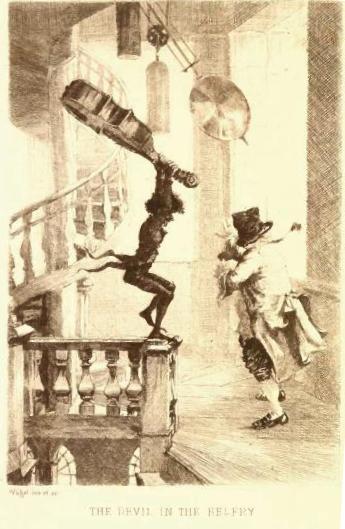
Poe’s 1840 collection, Tales of the Grotesque and Arabesque, further shows the evolution of his Romantic Satanism. Consider “The Devil in the Belfry” (1839), in which the Devil becomes one of Poe’s first apparitions of entropy, a companion to the fissure running through the contemporaneous “House of Usher” and a precursor to the later “Masque of the Red Death.” The punctilious citizens of the remote town of Vondervotteimittiss (wonder-what-time-it-is) are primarily preoccupied with clocks and cabbage until the arrival of a devilish fiddler who invades the belltower and rings thirteen o’clock. Here, the titular devil introduces disorder to the town’s tightly ordered system, but in doing so, admits the possibility of change and creativity.

George Barrie’s 1894 illustration for “The Devil in the Belfry.”

More than his earlier Faustian farces, this tale shows the influence of the German writer-philosophers, August and Friedrich Schlegel, in whose earlier writings Satan figures the freedom, infinity and chaos admitted by the systematically unsystematic exercise of irony. Friedrich Schlegel called irony “the clear consciousness […[ of an infinitely full chaos.” As James Clow puts it, “Schlegel does not really articulate a position … but instead saturates his writing with a self-reflexivity that both performs and explains the philosophical uses of irony.” Poe’s work is rife with Schlegel’s brand of self-reflexive irony, which had earlier influenced the Romantic Satanism of Percy Shelley, whose  essay “On the Devil, and Devils” calls Satan “the vulnerable belly of the crocodile” of Christian doctrine, a rebuke of John Mason Good’s Biblical and natural theological views. Shelley’s essay was not published until 1880, making it unknown to Poe. Yet there are striking parallels between the Romantic Satanisms of Shelley and Poe, although Poe ultimately takes Schlegel’s self-reflexive irony much further than his English predecessor in ways that weave his work into the literary foundations of the contemporary Satanic milieu.

“Ligeia,” “Morella” and Poe’s Esoteric Reception

Two other Tales of the Grotesque and Arabesque build on the narrative structure Poe initiated with “Berenice,” demonstrating how Poe’s Schlegelian irony led to his work’s embrace as a precursor to what, after Blavatsky, becomes called the “Left Hand Path” of modern esotericism. “Ligeia” and “Morella” are sister-tales of apparent metempsychosis, circulating around an unreliable narrator’s perception that his dead wife’s esoteric studies and tremendous will enable her rebirth into, respectively, the body of his second wife and that of his daughter. These tales shaped the concept of magical will used by later esotericists to distinguish between “right hand” and “left hand” practices, beginning with their adaptation by the African-American occultist Paschal Beverly Randolph, largely responsible for introducing “sex magic” practices to late 19th century audiences.

1874 photograph of Randolph, an admirer of Poe whose influence on Theosophy and related forms of modern Western esotericism is fascinating and critically under-recognized.

As Randolph’s biographer John Patrick Deveney explains, “The influence of Poe’s writings on Randolph is quite extensive.” A “constant refrain” of Randolph’s magical philosophy is that “men fail and die through feebleness of will.’”  Randolph attributes this idea in his seminal text, Ansairetic Mystery, to Joseph Glanville. The origin of this statement is not Glanville, but Poe’s epigraph to “Ligeia” attributed to him, which bears little relation to Glanville’s theological views. What it does strongly resemble is a stanza from Friedrich Schiller’s poem “Die Worte des Glaubens.” In John Herman Merivale’s 1844 translation:

                        And God is – a holy Will that abides,

Though the human will may falter;

High over both Space and Time it rides,

The high Thought that will never alter.

Johann Fichte included this stanza at the conclusion of his essay “On the Ground of our Faith in a Divine Government of the World” as exemplary of his own view, fuelling the Pantheismusstreit alluded to in “Morella” as the “wild pantheism of Fichte.” That Poe deploys Fichtean terms in such unsettling ways in these tales, written during the era of the Young America movement and the popularization of “Manifest Destiny,” when Fichte’s nationalist mysticism (which would later infuse Nazi occultism and other forms of radical religious nationalism) was percolating through antebellum American culture surely deserves further consideration, but is beyond the scope of this essay. At base, the Fichtean allusions in both tales emphasize that the human will can, through “intentness,” in effect become divine and abide eternally, facilitating Fichte’s reception as a philosopher of the Left Hand path for later esotericists, from MacGregor Mathers and Crowley to more recent proponents including Aquino and Stephen Flowers.

While originating in Blavatsky’s interpretation of contrastive tantric practices, the terms left- and right-hand path have evolved via later commentators to distinguish those who seek mystical union with the divine by a total surrender of individual self from those who seek to attain knowledge, power, or personal immortality through an act of self-apotheosis.  It is exactly such an act that the narrators of “Ligeia” and “Morella” claim to witness in the (however momentary and incomplete) conquest of death performed by their sinister wives.

Conclusion: Eureka, A(Poe)theosis and the Invention of “The Left Hand Path”

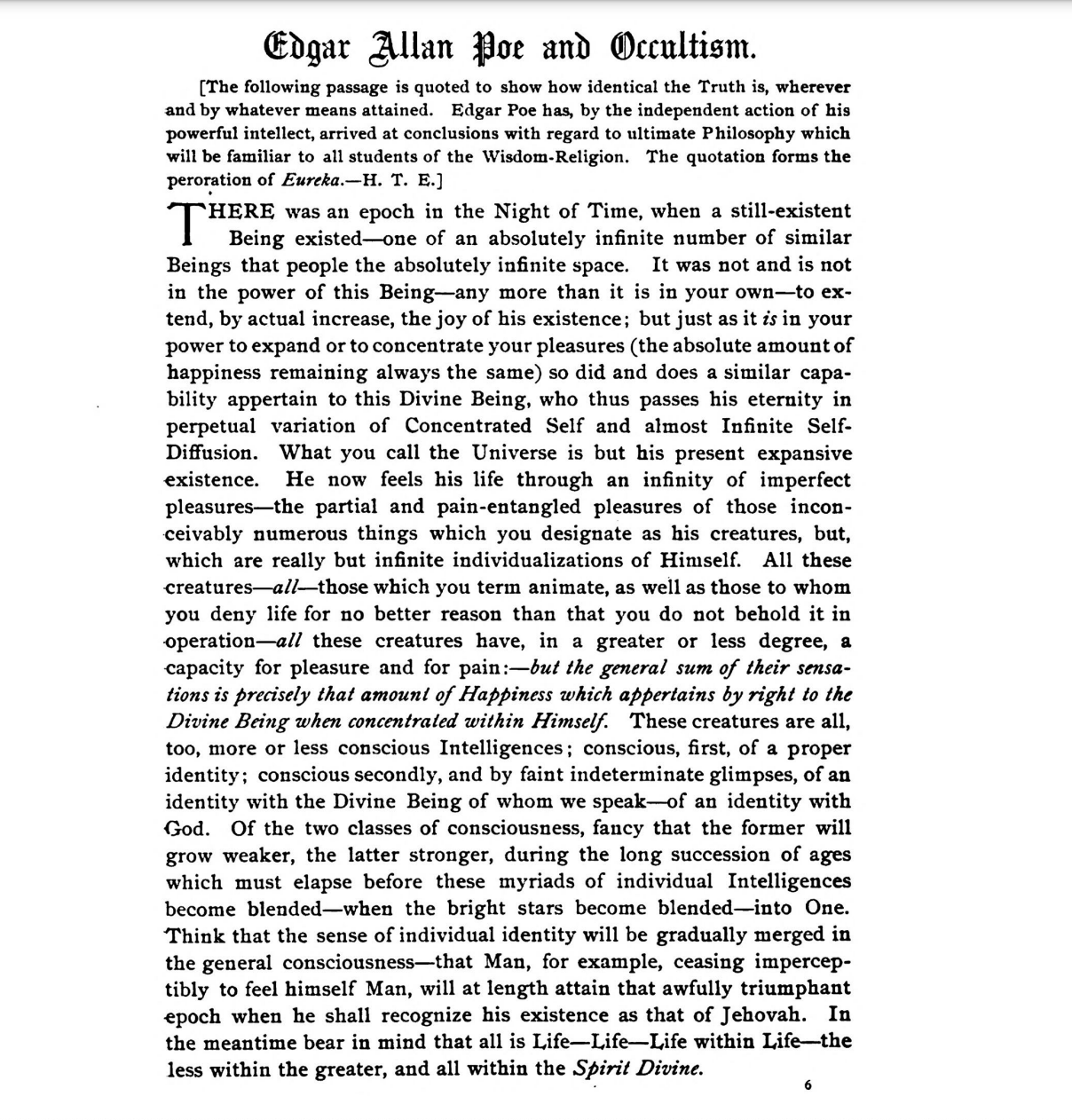
 These tales are far from the only writings by Poe to influence the worldview of later esotericists; Eureka has had an even greater influence in this regard. In 1893, the Theosophical Society’s official periodical, Lucifer (Vol. 12, March-August) included the brief article “Edgar Allan Poe and Occultism,” claiming that Poe, “By the independent action of his powerful intellect, arrived at conclusions with regard to ultimate philosophy which will be familiar to all students of the Wisdom-Religion.” It reproduces the passage from Eureka culminating in Man “will at length attain that awfully triumphant epoch when he shall recognize his existence as that of Jehovah.”  

Peter Gilmore, current High Priest of the Church of Satan, describes LaVeyan Satanism as not a form of “atheism,” but of “I-theism.” It’s a pun that Poe, as a (witting, willing or otherwise) “Lord of the Left Hand path” and literary architect of modern Satanism, made possible. His identification of divinity with humanity and ambiguous synthesis of Gnostic and Epicurean materials seeded the ground from which both modern rational and esoteric Satanism would spring. From the neo-Gnostic literary Satanism of The Revolt of the Angels, the 1914 Anatole France novel which serves as a core text for The Satanic Temple, to “satanic woman” Maria de Naglowska’s Randolph-inspired surrealist sexual ritualism, to Anton LaVey’s use of Satan as an adversarial floating signifier, Poe’s work has become foundational to an incredible proliferation of Satanic discourse over the last 150 years.


Tagged , , , , , , , , , , , , , , , ,