In the essay “Consolations of Horror,” American horror writer and philosophical pessimist Thomas Ligotti asks, “Did you ever wonder how a Gothic story like Poe’s masterpiece [“The Fall of the House of Usher”] can be so great without enlisting the reader’s care for its characters’ doom?”
Contradicting analyses that characterize the basis of horror fiction’s emotional appeal as dependent upon a reader’s identification with, and emotional mirroring of, a particular character, Ligotti proposes that, “Unlike a horror story whose effect depends on reader sympathy with its fictional victims, this one doesn’t want us to get involved with the characters in that way. Our fear does not derive from theirs.” Yet, despite its radical violation of this widely touted explanation of horror’s appeal, “Usher” is widely recognized as among the most effective and influential horror tales ever written.
Ligotti suggests this is because:
we don’t look over any character’s shoulder but have our attention distributed god-wise into every corner of a foul factory which manufactures only one product: total and inescapable doom. Whether a given proper noun escapes this doom or is caught by it is beside the point. Poe’s is a world created with built-in obsolescence, and to appreciate fully this downrunning cosmos one must take the perspective of its creator, which is all perspectives without getting sidetracked into a single one.
Why, then, have readers, for nearly two centuries, been drawn into the existential trap of Poe’s house? Ligotti concludes “the consolation” that “Usher” offers readers is that through the tale, we become “supremely removed from the maddeningly tragic viewpoint of the human.”
In his later essay The Conspiracy Against the Human Race. Ligotti describes the fundamental function and attraction of horror literature by explaining that:
Isolation, anchoring, distraction, and sublimation are among the wiles we use to keep ourselves from dispelling every illusion that keeps us up and running. Without this cognitive double-dealing, we would be exposed for what we are. It would be like looking into a mirror and for a moment seeing the skull inside our skin looking back at us with its sardonic smile. And beneath the skull—only blackness, nothing. Someone is there, so we feel, and yet no one is there—the uncanny paradox, all the horror in a glimpse.
Ligotti’s own influential fictions are designed to disrupt such “cognitive double-dealing” by corroding the most cherished self-representations and pretensions of humanity; depending on the reader, the effects of such literary corrosion can be humorous, horrifying, or, most unsettling, both simultaneously.
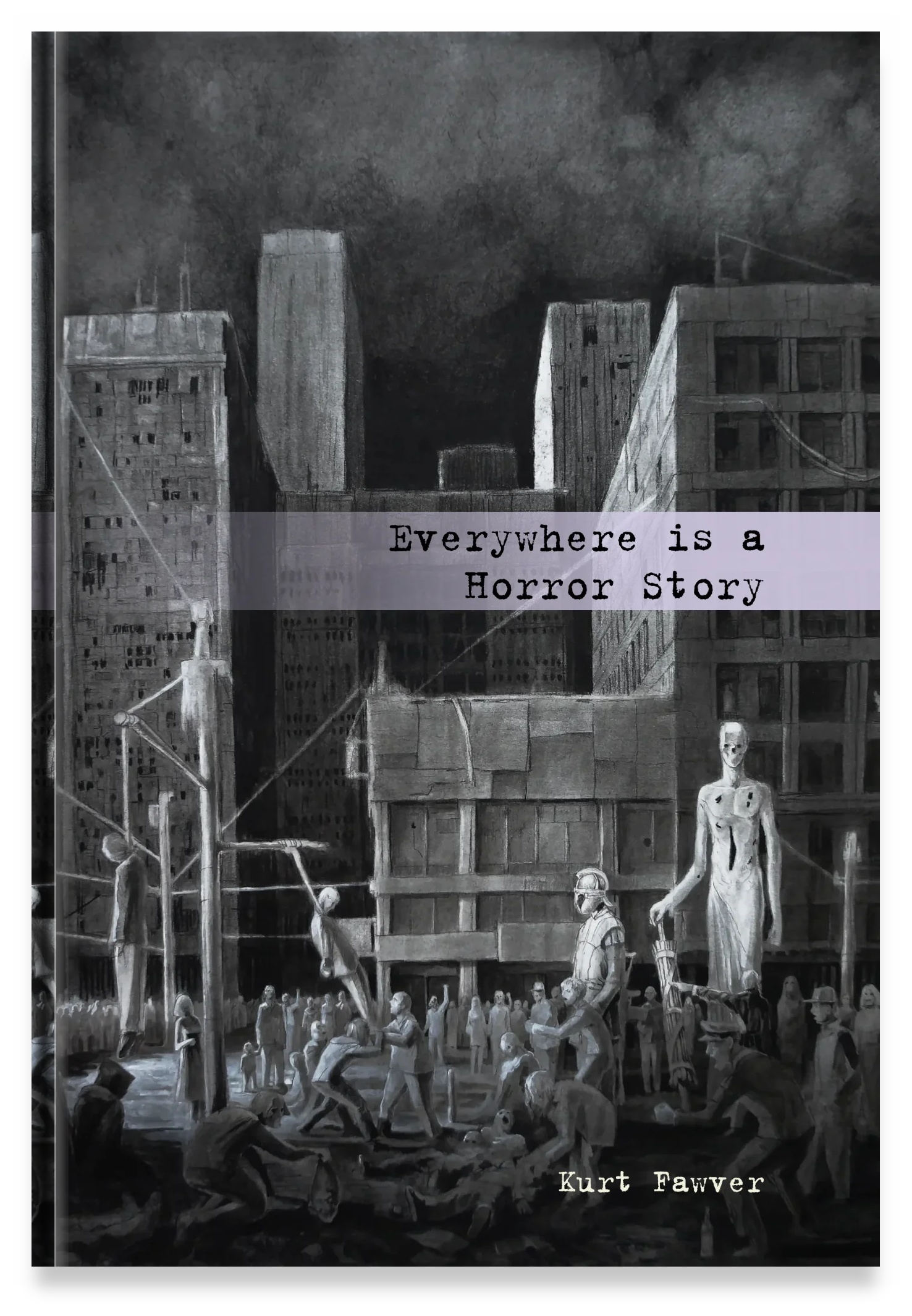
This is an effect that Kurt Fawver’s collection of short stories Everywhere Is a Horror Story, published by Grimscribe Press, frequently manages to attain. Grimscribe Press is an independent horror and weird fiction publishing house run by editor, author, narrator and ventriloquist Jon Padgett. The press itself takes its name from Ligotti’s work, echoing the fictional curator of Ligotti’s collection, Grimscribe: His Life and Works, and Ligotti’s shadow looms large over the luminous, ruinous, atmospheric work which Grimscribe consistently showcases.
This is absolutely true of Everywhere Is a Horror Story, Fawver’s fourth story collection, following Forever, In Pieces (Villipede, 2013), The Dissolution of Small Worlds (Lethe Press, 2018) and his previous collection from Grimscribe (my introduction to his fiction) We Are Happy, We Are Doomed (2021). Over the course of these collections, Fawver has established himself as a compelling and crucial voice in contemporary weird fiction. With Everywhere Is a Horror Story, he works wonderfully as a miniaturist, with some of the best stories possessing an almost Borgesian suggestive compression.
Fawver is masterful at taking highly abstract and even bizarre premises and concepts and rendering them plausible, impactful, undeniable, through the use of punctuating imagery and arresting details. As a whole, the collection wriggles around the intersection of metaphysical dread and comic absurdity, and Fawver’s mordant voice and formal mastery are impressively displayed throughout these fourteen protean and restless stories.
Everywhere Is a Horror Story opens with “Introduction to the Horror Story, Day 1,” an incisive exercise in sado-pedagogical narrative which echoes classic metahorror lecture-texts like Ligotti’s “Professor Nobody’s Little Lectures on Supernatural Horror” and John Langan’s “Technicolor.” “Introduction” adumbrates a lecture delivered to a creative writing classroom by a menacing professor who muses that it is when a horror story “can break free from its fictional bindings and creep into the real world” that it “has achieved transcendence” (19).
One technique Fawver uses frequently, and often to great effect, throughout these fictions is the first-person plural. Like those of Faulkner’s “A Rose for Emily” or Ligotti’s “The Shadow At the Bottom of the World,” his narrators present themselves as speaking for communities, organizations, institutions, most of them suspicious or obscure. The most poignant use of this technique is the story “Problems in River Heights,” whose narrator concedes (in an understatement whose chilling import only later becomes apparent) that “Because we felt powerless, we let our greatest source of power—community—fall to pieces.” (115)
While many of Fawver’s stories seem written with tongue firmly in cheek, they refuse to offer the comforting chuckles and shared winks of condescending genre parody; instead, this tongue compulsively investigates the sudden appearance of a strange pustule or suppurating crater in the cheek’s familiarly strange terrain. For example, Fawver memorably vivisects and re-sutures the conventions of the slasher film in the briefly bloody offering with which the collection concludes, “This Story Will Kill You.” Archly metafictional, this story pares back both plot and description to skeletal remains. As the title telegraphs, the slasher here, whatever else it may or may not be, is the story itself: as the narrator wryly notes to the story’s next prospective victim, “One way or another, it’s a monster, Julia, a metaphor, and you can interpret it however you choose.” (282)
Other stories from the collection that especially stuck with me include: the bleakly funny “Workday,” which delivers chilling corporate horror via an epistolary narrative form, taking the shape of an escalating series of internal memos and email chains; the grotesquely mutated fairy-tale “In the Shoe, Ascending”; the ingenious and poignant haunting of “Parturition”; the delightfully deconstructed Christmas-ghost-story-meets-Cards-Against-Humanity-game-night “Flicker and Burn”; and the scatological, but also strangely tender “Flushed,” one of whose sentences serves as a lapidary gloss on Fawver’s entropic vision itself: “Thus, the unexplained events ended as abruptly as they’d begun and the city resumed its descent into a more peaceful decay.” (243)
In Fawver’s fictions, meaning and absurdity, horror and humor, are pointedly of a piece, and it is their interposition that makes these stories so delightfully disruptive. However, with their hermetic drift and cerebral sensibility, they may not appeal to readers looking for more traditional, linear, character-driven fictions; they may also fail to sate gore-hounds on the hunt for a hit of latter-day splatterpunk.
For like some of Poe’s and Ligotti’s best fictions, Fawver’s can take essayistic and esoteric routes in winding readers through their miniature mazes of dread and dark laughter. These, however, are precisely the qualities that make Fawver’s work so atmospheric, so unnerving, and ultimately, so worth getting lost in, however momentarily, before resuming our “descent into a more peaceful decay.”

