Tag Archives: George M. Gould

Lovecraft, Lucretius, and Leonard’s Locomotive-God: Further Thoughts on Cosmic Horror

This post is a companion to and continuation of “‘The Dread Contemplation of Infinity’: Some Thoughts on George M. Gould and Cosmic Horror Before Lovecraft,” Where that essay explores how Lovecraft’s conception of cosmic horror is best understood as a transvaluation of that which predominated from the 1880s through to the 1930s, this essay further explores Lovecraft’s developing conception of cosmic horror by focusing on another of Lovecraft’s under-recognized contemporary influences; namely, the American professor, poet, memoirist, and translator, William Ellery Leonard. This post is based on the conference paper, “From Beyond the Pleasure Principle: Freud, Lucretius, Lovecraft and The Locomotive-God,” which I presented as part of the Henry Armitage Symposium at NecronomiCon in August, 2019. Some of the material on Lucretius, Poe and Lovecraft in the first section is drawn from my essay “The Poet’s Nightmare: The Nature of Things According to Lovecraft.” If you want a more developed (and fully cited) version of that material, you’ll find it there.

Much of this material will be further developed in my in-progress book, tentatively titled Repulsive Influences, which provides a genealogy of cosmic horror while exploring the intersecting histories of Lucretius’s reception and the emergence of Anglophone gothic, horror and weird fiction.

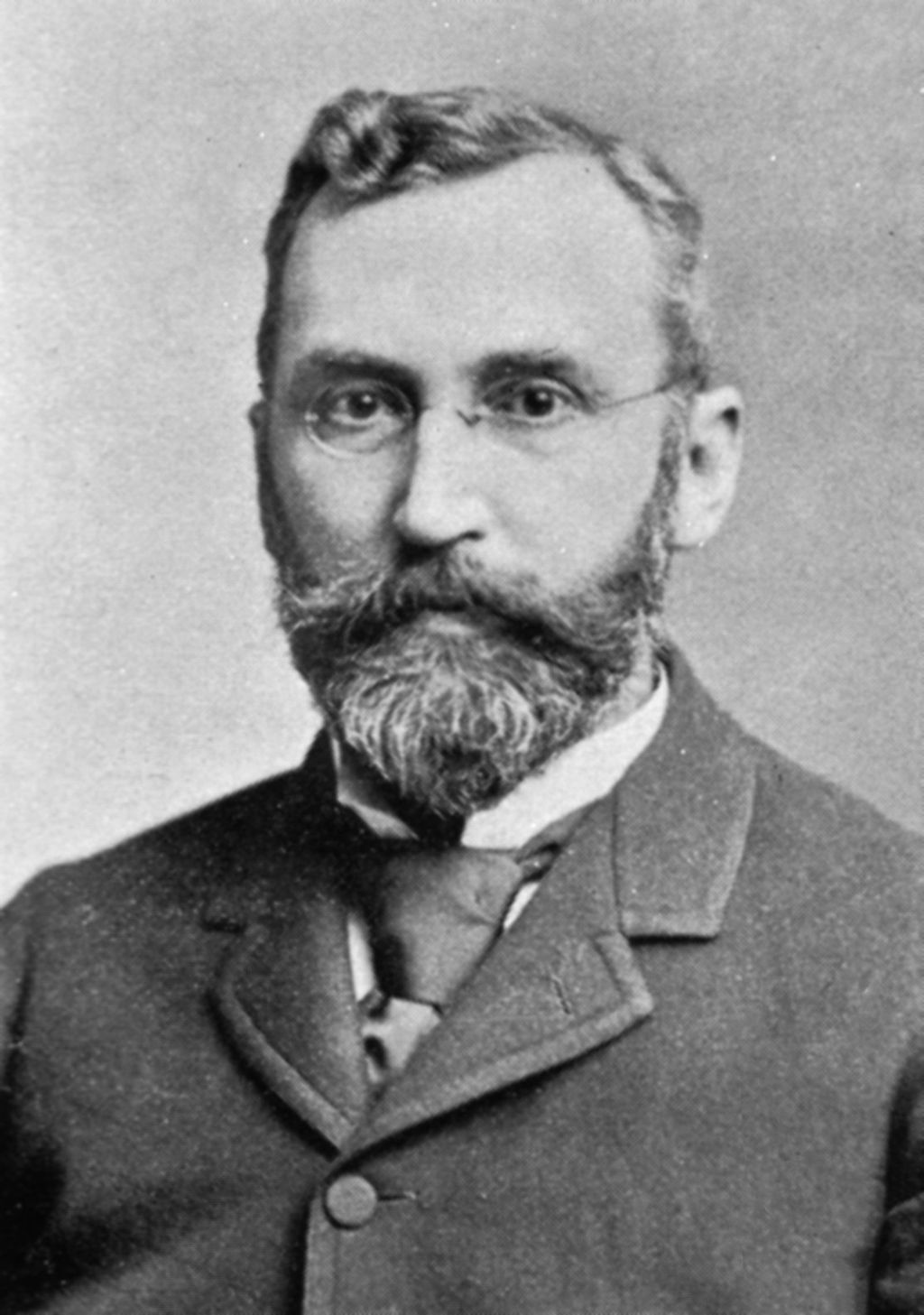
William Ellery Leonard (1876-1944)

LEONARD, LUCRETIUS AND LOVECRAFT

The first American to publish a complete English translation of Lucretius’s epic didactic poem De rerum natura was a professor of Classics at the University of Wisconsin named William Ellery Leonard (for an extensive study of Leonard’s life and work, see Neale Reinitz’s The Professor and the Locomotive-God.)

While his work is little read today, Leonard was among the most widely known American writers of his day, renowned both for his translations of Greek, Roman and Anglo-Saxon poetry and for his own poetry and his two memoirs, Two Lives and The Locomotive-God. The latter focuses entirely on the traumatic phobia that overshadowed Leonard’s life, and was widely read, both by psychologists (including Freud, whose correspondence with Leonard became part of the book) and general readers who were fascinated by Leonard’s minute, dramatically written analysis of his own “case.” Lovecraft thought highly of The Locomotive-God as a psycho-biographical memoir, and his curiosity regarding Leonard was no doubt intensified because, while it does not appear they ever met personally, they had only two degrees of separation via a number of members of Lovecraft’s Circle. Both men were friends with August Derleth, who was among Leonard’s pupils, and both also wrote appreciations of Frank Belknap Long’s writings

Quite apart from their shared social connections, Leonard’s writings bear importantly upon Lovecraft’s in ways that have, to my knowledge, never been critically explored. This essay focuses on two apertures through which Leonard’s work influenced Lovecraft’s developing conception of cosmic horror.

EDGAR POE AND LUCRETIAN COSMICISM

The first occurs in 1916, with the publication of Leonard’s translation and interpretations of Lucretius, On The Nature of Things. Leonard’s translation includes an end-note appended to the first instance of his use of the term Cosmos in translating part of Lucretius’ opening Hymn to Venus (DRN I 21). Leonard justifies his lexical choice by writing:

“In Greek, a technical term of that Stoic philosophy to which Lucretius was opposed; but in English fairly equivalent to the Epicurean “natura rerum,” through the associations of the word with Spencer’s “Cosmic Philosophy” and with modern materialism.”
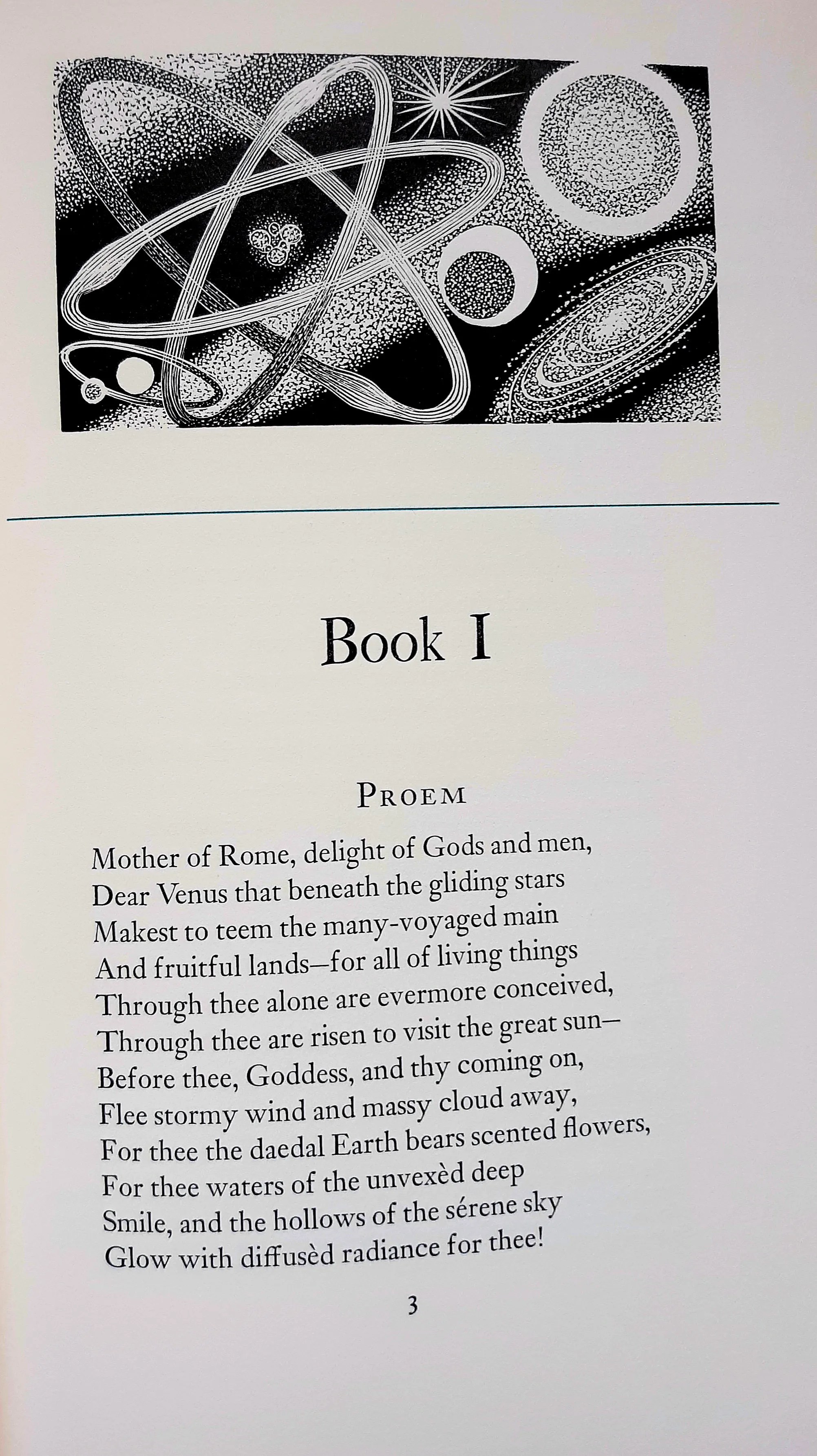
Paul Landacre’s illustrations for the Limited Edition Club’s 1950s reprint of Leonard’s translation beautifully capture the cosmic sensibility of the poem.

Lucretius’s avoidance of the Greek word cosmos is informed by its teleological connotations, but Leonard suggests that these connotations need no longer apply given the term’s adoption by modern materialist thinkers. Lovecraft seems to have shared Leonard’s view in this respect, as his adoption of the term cosmicism to characterize his own philosophical sensibility suggests. Indeed, Lovecraft’s cosmic vision, following from Lucretius’s, is radically opposed to teleological assumptions about the natural world. S.T. Joshi writes:

“The central tenet in what Lovecraft called his “cosmic indifferentism” is mechanistic materialism. The term postulates two ontological hypotheses: 1) the universe is a “mechanism” governed by fixed laws (although these may not all be known to human beings) where all entity is inextricably connected causally; there can be no such thing as chance (hence no free will but instead an absolute determinism), since every incident is the inevitable outcome of countless ancillary and contributory events reaching back into infinity; 2) all entity is material, and there can be no other essence, whether it be “soul” or “spirit” or any other non-material substance. Lovecraft evolved these ideas through a lifelong study of ancient and modern philosophy, beginning with the Greek Atomists (Leucippus and Democritus), their followers Epicurus and Lucretius (whose belief in free will Lovecraft was forced to abandon), and such modern thinkers as Ernst Haeckel, Thomas Henry Huxley, Friedrich Nietzsche, Bertrand Russell, and George Santayana. Lovecraft’s metaphysical views seem to have solidified around 1919, when he read Haeckel’s The Riddle of the Universe (1899; English translation 1900) and Hugh Elliot’s Modern Science and Materialism (1919).”

What effect Leonard’s translation and commentary may have had in shaping Lovecraft’s philosophical views is difficult to determine; in all likelihood, it was probably minor. The verbal and aesthetic parallels between Leonard’s translation and some of Lovecraft’s writings from this period, however, are intriguing, and particularly the “Aletheia Phrikodes” section of Lovecraft’s 1918 poem “The Poe-et’s Nightmare.” While the larger poem’s mock-epic structure is a love-letter from Lovecraft to his Augustan idol Alexander Pope, once called the “English Lucretius,” the “Aletheia Phrikodes” section is a cosmic stew in which blank verse Lucretian imitation is peppered with allusions to Edgar Allan Poe, beginning with the longer poem’s original title itself. One brief section serves to illustrate how Lovecraft twines Lucretius and Poe together:

Whilst whirling ether bore in eddying streams
The hot, unfinish’d stuff of nascent worlds
Hither and thither through infinity
Of light and darkness, strangely intermix’d;
Wherein all entity had consciousness,
Without th’ accustom’d outward shape of life.
Of these swift circling currents was my soul,
Free from the flesh, a true constituent part;
Nor felt I less myself, for want of form. (italics mine)
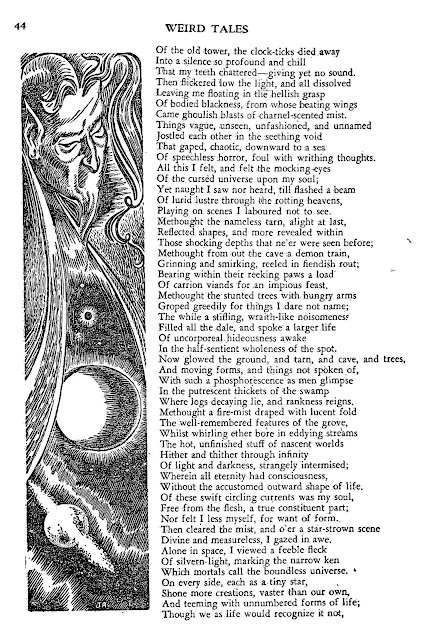
The visual interplay between Jon Arfstrom’s illustrations for Lovecraft’s poem in Weird Tales and Landacre’s illustrations for Leonard’s Lucretius is striking.

At once cosmogony and nekuia, The passage is part of an extended improvisation on both DRN V’s astronomic and meteorological passages and DRN III’s descriptions of the soul’s perishable materiality, but it also invokes Poe’s cosmic vision in early poems like “Al Aaraaf” and the cosmological prose poem, Eureka. In describing these fluctuating vortexes of metamorphic materiality as “eddying” streams, Lovecraft emphasizes the Poe-etic nature of this cosmic maelstrom.

That Lovecraft and Leonard shared an appreciation for Poe as cosmic visionary, a sort of American Lucretius, is certain. Such a view had been propounded by James A. Harrison, in his 1902 edition of Poe’s collected works; Harrison declared that “Both, in their poems, were passionate inconoclasts, idealists, dreamers of the speculative philosophies that looked into the causes of things; both set aside what they considered the degrading superstitions,” and were “refined materialists of an almost spiritual type,” which likely shaped both Lovecraft and Leonard’s associations between Lucretius and Poe.

Poe’s work is rife with eddying whirls and turbulent vortices, some of which spiral down into the oceanic depths, others of which whirl up and out through the unfolding universe of stars. Indeed, the spiral, in the dynamic form of the vortex, is the most pervasive and important motif in Poe’s writings, and engenders his aesthetics of the grotesque and arabesque, as Patricia Smith observes:

“The arabesque as Poe sees it is an attempt to suggest something kinetic — the motion toward unity — in a static medium; symbolically, it is always moving in the direction of the form-obliterating spiral. The man whirling about on Aetna resolves all he sees into a radical blur by means of his spin; the universe itself, in Eureka, collapses ultimately into a state of nihility. As in the Maelstrom, where all things “meet together at the bottom,” the final vision toward which the arabesque points is one in which unity is perceived, and it is impossible to distinguish one thing from another.”

Poe’s vortexes reflect his materialist metaphysics, which in turn derive from his own transformative reception of the classical atomist influences he shares with Lovecraft. Whether Lovecraft had read Leonard’s entire translation before drafting his poem is unclear, although he was certainly aware of its existence, and likely to have seen excerpts, as it was widely reviewed and noticed. That he had done so by 1922 is almost certain, as he mentions it approvingly in a letter to Lillian Clark, while noting that Derleth gifted a copy to Sonia Greene : “The generous little divvle is making presents on a large scale–Smith’s ‘Star Treader’ for me, an art book for Kid Belknap, & Leonard’s translation of Lucretius for Mrs. Greene–with whom he is trying to make up after his rudeness of last spring. Leonard is his English professor at the U. of Wis.–a scholar of note.”  

Leonard’s phrasing reinforces the resemblance between this passage in DRN and Poe’s description of the whirlpool in “A Descent into the Maelstrom,” a tale that signals its own atomistic underpinnings by both its epigraphic reference to the Democritean δῑ́νη and its deliberate echo of Lucretius’s most famous passage, the “suave mari magno” description of a shipwreck that opens DRN II.
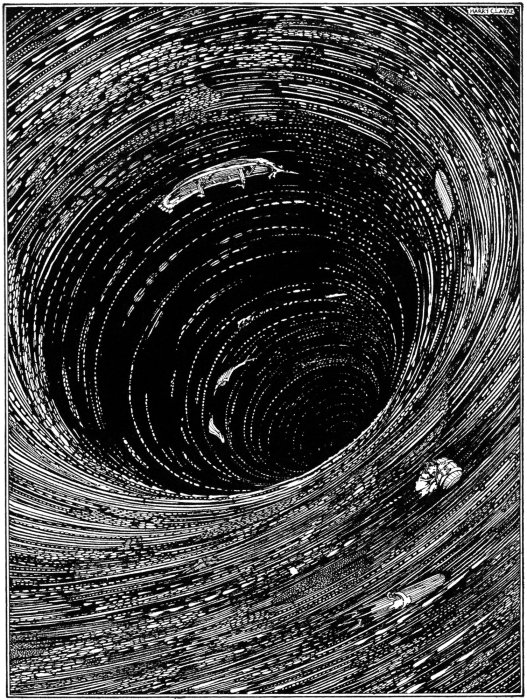
Harry Clarke’s illustration (1919) for Poe’s “Maelstrom,” much admired by Lovecraft.

Leonard makes his Poe-tical homage even more evident a few pages later. Lucretius provides a naturalistic explanation for the absence of birds at Greek oracular sites including Cumae, an absence traditionally attributed to the awful supernatural influence of the gods. Instead, Lucretius explains that noxious gases that leak forth from the earth keep the birds away from such sites, which Leonard renders as “birdless tarns,” echoing Poe’s use of this antiquated term in describing the miasmic body of water into which the House of Usher falls. Leonard’s translation reads:

            And such a spot there is

            Within the walls of Athens, even there

            On summit of Acropolis, beside

            Fane of Tritonian Pallas bountiful,

            Where never cawing crows can wing their course,

            Not even when smoke the altars with good gifts,–

But evermore they flee—yet not from wrath

Of Pallas. (VI.280)

This echo of  “The Raven” suggests, much as “The Poe’et’s Nightmare” does, Poe’s concatenation with Lucretius. Whether Lovecraft had read all of Leonard’s translation at this stage is unclear, but it nonetheless telling that both writers, soi-disant opponents of Poundian Modernism, returned to the Democritean δῑ́νη via such parallel descents.
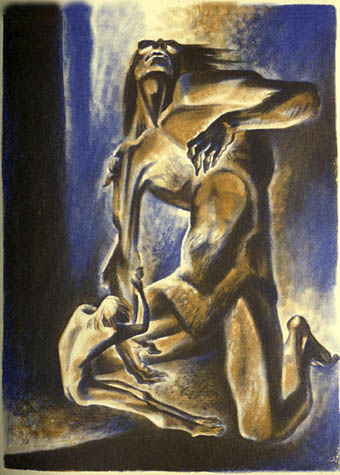
Beowulf battling Grendel in one of Lynd Ward’s illustrations for Leonard’s translation.

LUCRETIUS, FREUD AND LEONARD’S LOCOMOTIVE-GOD

A decade before Leonard published his 1927 psycho-biographical account of his phobic obsessions, The Locomotive-God, his often- incapacitating agoraphobia was already reflected in the anxious intensity and alienation of his translations. In Leonard’s Lucretius, the descriptions of immensity and the void and the characterization of the monstrous Religio are particularly harrowing, as are his renditions of Grendel and the dragon in Beowulf, and each of these draws force from the compulsive power of Leonard’s growing anxiety.
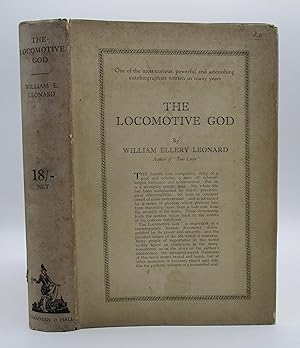
The cover of a 1928 printing of The Locomotive-God

 Leonard’s phobia worsened considerably after 1918, in the wake of the catastrophic First World War. Near the opening of the book, Leonard writes:

“What was so poignantly my subconscious mind reveals itself, by the laws of our most common organic structure and development, as the mind of mankind. My own pain, my own struggle, has been, even to myself, a spectacle, a laboratory. And my findings differ in some ominous particulars from the previous record of poets and psychoanalysts. I have been persuaded […] by the desire to frustrate, by a neat and unexpected turn, those Demonic Forces which, as appearances go, have backed me for so many years against the wall. Beset by phobias, shell-shocked in a civilian war […] So out of very suffering and very failure I would create value: the value of a scientific document, the value of a work of art.”

When atoms meet in the void through the clinamen, they can combine, or they can collide. Thus, attraction and repulsion are the fundamental principles of Epicurean physics. Lucretius, however, renders these in mythological terms derived primarily from Empedocles: Venus is a personification of attraction and combination, and Mars of repulsion and collision. In his post-war writings, especially Beyond the Pleasure Principle, Freud returns to such an Empedoclean mythic polarity with his conception of The Death Instinct as a counter to the Pleasure Principle.

It is a conception inspired, as W. Scott Poole emphasizes in his study of the Great War’s decisive influence on modern horror, by Freud’s horror at the catastrophic consequences of the war, consequences that Leonard also believed to have intensified his phobia, amplifying the power of the Locomotive-God over his mind and behaviour.

Leonard expresses this revelation in terms that are both explicitly Freudian, and explicitly Lucretian:  “The “love-emotion” “could relive but not break the tension of the tangled mythology in which the subconscious in its deepest levels still believed…and still believes. The Locomotive-God won even against Aphrodite, goddess of manhood.”

The Locomotive-God traces Leonard’s trauma-induced phobic paralysis to a memory from his early childhood. As a two-year-old-child, he stood on a platform and watched a train pulling into the station. Disregarding his mother’s cries, he wandered to the edge of the tracks, until:

“It towers and lowers and grins in one awful metamorphosis, more grotesque than the most bizarre dreams of Greek mythology […] As It roars over the bridge […] scattering dust and strewn newspaper, the black circle of the boiler-front swells to the size of the round sky out of which the Thing now seems to have leaped upon me [….] this Aboriginal Monster. My eyeballs, transfixed in one stare, ache in their sockets.”

This terrifying memory would superimpose itself over, and come to stand for, every subsequent traumatic event Leonard would experience in his life. He writes,

“To me at a little more than two years, the Black Circle flashes a fiercely shaking Face of infinite menace, more hideous and hostile than Gorgon-shield or the squat demon in a Chinese temple, with gaping Jaws, flanked by bulging jowls, to swallow me down, to eat me alive—and the Thing is God […] God roaring from heaven to slay me for having disobeyed my mother and gone so close to the track.”

As an older child, Leonard would witness a cat struck by a train, which triggered the original trauma: “the cat got tangled up in the unseen web of my thought with the instrument of its death—the locomotive.” This led Leonard to claim that “terror is the supreme emotion of life, and it borrows its color from its Master, Death.”

As Leonard wrote his translation of Lucretius, “the Thing” would colour his descriptions not just of the immensities of the void, but also the description of Religio, Lucretius’s figuration of religion as a feminized embodiment of irrational compulsive power, that very force that Epicureanism is supposed to overcome. It is a figuration that resounds throughout Lovecraft’s non-fictional writings on atheism as clearly as his tales of malignant cults. Leonard speculates that “Much that we call Superstition is really Phobic Fear, not understood as such by the victim or those who gird at the victim; even as Phobic phenomenon have surely been a prime source, feeding the speculations and prepossessions of theologies pagan and Christian, of the belief in witchcraft.”

LOVECRAFT AND THE LOCOMOTIVE-GOD

            The Locomotive-God’s influence on Lovecraft has gone largely unremarked, but it is hard to overstate its importance. More than any other single influence, it led Lovecraft further away from Gould’s predominant conception of cosmic horror, and helped cement for him the importance of the work on the nature of horror being done by psychologists including John B. Watson (on which see Dr. Sharon Packer’s essay) and Freudian psychoanalysis.

Leonard’s characterization of terror as “the supreme emotion of life” resonates powerfully with that with which Lovecraft begins his own 1927 essay on supernatural horror. Leonard’s frenetic description of the Locomotive-God, with its fusion of animal and vehicle, raw machinic power and perverse vitality, industrial modernity and primordial psychic dread, resonates powerfully with many of Lovecraft’s post-1929 monsters; most obviously, the shoggoths of 1931’s At the Mountains of Madness derive much of their terrifying imagery and potency from Leonard’s Locomotive-God.

Illustration of a shoggoth from At the Mountains of Madness by Nottsuo from Deviantart.

In a 1929 letter to Derleth, Lovecraft acknowledged Leonard as “A character, & a figure of real importance in American letters.” By this point, he had read The Locomotive-God, and his letters praise the penetrating psychology of traumatic obsession that Leonard’s book offers. For example, a 1931 letter recommends it to Robert E. Howard as essential reading for anyone interested in psychobiography. As his recommendation to Howard reinforces, The Locomotive-God was crucial to Lovecraft’s conception of the power of atmosphere, the sine non qua of cosmic horror. Leonard’s provision of a mechanistic explanation for his own psychic trauma was especially valuable to Lovecraft as of 1931, as at this stage in his career he was explicitly looking for ways to generate “an atmosphere” of cosmic dread without turning to the superstitious tropes of classic supernatural horror.  Leonard writes,

“The mechanism in its technique can be made clear to the reader. We start with a state of terror generated by past experience. The past experience itself remains in the subconscious. Its emotional effect, terror, bursts into consciousness. At times the emotional effect remains merely a diffused state of terror, in intensity running the whole scale from vague anxiety to intensest feel of impending death; and the agonized mind stands balked of any explanation whatever.”

Lovecraft later praises Leonard’s insight into his phobic experiences in a 1931 letter to Maurice Moe: “Unless one is steeled against the ascendancy of the capricious and meaningless subjective feelings, he is lost so far as the power of rational appraisal of the external world is concerned. Thus poor W. E. Leonard sees and feels things that aren’t there–and knows he does–yet continues to see and feel them just the same. That shows the power of irrational mood over rational perception.” It is precisely this power that, from 1927 on, Lovecraft, departing further from Gould’s nineteenth-century medico-theological concept, sees as the sine non qua of the best supernatural horror fiction, and, reinforcing his adoration of Poe, comes to term an “atmosphere” of “cosmic dread.”


.
Tagged , , , , , , , , , , , , , , , , , , , , , , , , , ,

“The dread contemplation of infinity”: Some Thoughts on George M. Gould and Cosmic Horror Before Lovecraft 

This post is based on the conference paper I delivered as part of the Henry Armitage Symposium, the academic track of NecronomiCon, held in Providence, RI, from August 15-18, 2024.

Abstract (TLDR!)

In order to better understand the extent and importance of Lovecraft’s conception of “cosmic horror,” we need to recognize it as a transvaluation of a term already widely circulating in the first thirty years of Lovecraft’s life. During this era, the term “cosmic horror” derived primarily from the (at the time, highly influential) writings of American physician, ophthalmologist and medical lexicographer, George Milbry Gould. This short essay builds on one small part of the larger argument of “The Birth of Cosmic Horror from the S(ub)lime of Lucretius,” included in the essay collection New Directions in Supernatural Horror Literature, published by Palgrave in 2018 (if you’re looking for a peer-reviewed and properly citational version of the basic argument, use that.) I develop these connections further and more formally in my in-progress book, which offers a literary-historical genealogy of cosmic horror.

George Milbry Gould (1848-1922)

“The eternal silence of these infinite spaces fills me with dread”

Since the mid 20th century, the phrase “cosmic horror” has been closely associated with the writings of H.P. Lovecraft. While Lovecraft’s critical and fictional writings did much to popularize the phrase and develop the concept of cosmic horror as a literary mode closely linked to a philosophical perspective, both the phrase and the emotion it designates have a much older and broader history. For example, American horror writer and philosophical pessimist Thomas Ligotti looks back to the writings of French scientist and Christian philosopher Blaise Pascal for an early modern conception of cosmic horror. Pascal wrote of his a sense of being “engulfed in the infinite immensity of spaces whereof I know nothing, and which know nothing of me; I am terrified. The eternal silence of these infinite spaces fills me with dread.” In Ligotti’s words, “Pascal’s is not an unnatural reaction for those phobic to infinite spaces that know nothing of them.” 

The S(ub)lime of Lucretius

I’ve elsewhere argued that one can look back further and find a close conceptual and affective kin to what Lovecraft calls “cosmic horror” in the ancient world; namely, the reception of the Latin epic didactic poem De Rerum Natura by Lucretius, whose presentation of a fluctuating universe arising from the unpredictable encounters between atoms falling through the void occasioned a reaction of mingled awe and horror from both many pagan and Christian writers of late antiquity (such as Cicero and Ovid on the one hand and Lactantius and Prudentius on the other), a reaction echoed by early modern writers including Thomas Hobbes, Lucy Hutchinson and John Milton, Gothic novelists including Horace Walpole, Mary Shelley, Marie Corelli, and eventually, even Lovecraft himself, who by the 1930s repudiated his intense self-identification with Epicurean philosophy due to the foundational role the unpredictability of the clinamen, or atomic swerve, played in its metaphysical materialism, expressing a reaction of abject horror that ironically echoed that of most earlier theistic commentators (see my essay, “The Poet’s Nightmare: The Nature of Things According to Lovecraft.”)

Anomalous Sources

My focus here is more narrowly on the conception of cosmic horror that prevailed during the decades leading up to Lovecraft’s revaluation of the term; this conception was one advanced by George M. Gould.  I’m not the first to point out Gould’s pre-Lovecraftian use of this term, although I am the first to explore its influence and significance. In a 2015 editorial, Paul Di Filipo explains that this literary mode is “sometimes dubbed ‘Lovecraftian fiction’ in honor of its most famous exponent …whose work helped to crystallize and codify the subgenre,” but also notes that the “phrase itself predates Lovecraft, being found even in such anomalous sources as George Milbry Gould’s (1848-1922) The Meaning and the Method of Life: A Search for Religion in Biology (1893).

Di Filipo’s characterization of “cosmic horror” in Gould’s writings as “anomalous” is ironic for two reasons. First, it reflects the reality that Gould remains most famous for his 1896 compendium, Anomalies and Curiosities of Medicine, a compilation that would remain at once a standard medical, and a widely popular, reference work for half a century. Anomalies and Curiosities of Medicine has directly influenced a number of 20th and 21st century works of horror fiction, having often been used as a source of inspiration by writers and film-makers. For example, it was the source through which numerous horror creators found the apparently apocryphal case of Edward Mordrake, whose horrible story has inspired tales by Robert Bloch, episodes of TV series including Tales from the Crypt and The X-Files, and James Wan’s film, Malignant (2021.)

Annabelle Wallis in Malignant (2021), whose concept was inspired by an apocryphal case described in Gould and Pyle’s Anomalies and Curiosities of Medicine

 Second, di Filipo’s quip suggests that Gould’s concept of cosmic horror, unlike Lovecraft’s, is something of an oddity or outlier. In fact, while it has been almost entirely eclipsed by Lovecraft’s since the 1940s, it was widely influential from the early 1890s until the 1920s, and the subject of debate in medical, natural philosophical and theological discourses during that time. Gould wrote about cosmic horror frequently, not just in specialist medical and theological venues, but in widely read popular periodicals like The Atlantic. Gould’s conception of cosmic horror should thus be of interest not just to students and scholars of Lovecraft, weird and horror fiction, but should also interest students and scholars of early 20th century American  history, the history of medicine and the medical humanities.

George M. Gould

            Gould served the Union in the Civil War and his youthful war experiences shaped his outlook, feeding his interest in both medicine and theology. These interests led him to study theology at Harvard Divinity School and later to study medicine at Jefferson Medical College. He graduated in 1889 and opened an ophthalmology office in Philadelphia, where one of his first clients was the poet Ezra Loomis (later better known as Ezra Pound) who would subsequently recommend Gould to James Joyce, who suffered from a variety of ocular problems. Gould edited the Medical News (1891-1895), the Philadelphia Medical Journal (1898-1900) and American Medicine (1901-1906), earning numerous offices and honors over the course of his career. During this period he also exchanged many letters with his older contemporary and fellow “literary physician” S. Weir Mitchell, best remembered for the “rest cure” treatment to which he subjected Charlotte Perkins Gilman.

“Morbid Vision”

Gould wrote most often on ophthalmology, but his legacy as a medical lexicographer is  broad. His medical dictionaries sold nearly a million copies and he was also a prolific author of various literary works, including poetry and a series of what he called “biographical clinics,” or diagnostic biographies of famous artists and intellectuals, including Charles Darwin, Thomas de Quincey, and Gould’s friend and sometime correspondent, the writer Lafcadio Hearn. Gould’s “Biographical Clinics” often conclude that the peculiar perspectives of these influential figures is linked to their ocular abnormalities; he believed that “morbid vision” often leads to a “morbid metaphysics.” Indeed, for Gould, the eye was best understood as the external portion of the brain, and he pushed the connection of literal vision to rational thought to extremes – the eyes, for Gould, came to occupy a position of metaphysical privilege, much like the penis for his Viennese contemporary, Freud.

An excerpt from Gould’s study of Hearn illuminates how closely linked his concept of cosmic horror and diagnostic practices were:

“Hearn was no “product of his environment… The great, the distinctive, the dominating force which controlled and created Hearn’s literary makings, his morbid vision, was not “environment” as the critics and scientists mean by the term. These have not yet learned that Art and Life hang upon the perfection and peculiarities of the senses of the artist and of the one who lives, and that intellect and especially aesthetics are almost wholly the product of vision. Conversely, the morbidities and individualisms of Art and Life often depend pre-eminently upon the morbidities of vision.”

Hearn and the “new pathology of genius”

Gould saw Hearn as exemplifying “a new pathology of genius …coming into view which shows the morbidizing of art and literature through disease, chiefly of the sense-organs of the artist and literary work-man, but also by unnatural living, selfishness, sin, and the rest.” Gould presents Hearn’s personality and writings (in which Lovecraft also found an anticipation of cosmic horror) as characteristic of this modern morbidity, and claims he influenced Hearn’s decision to relocate permanently to Japan. Hearn had in common with both Gould and Lovecraft a suspicion of and even contempt for modern, urban, cosmopolitan industrial life, and Gould suggests that Hearn’s embrace and adaptation of ancient East Asian folklore and traditions offered a means of moving beyond the paralyzing cosmic horror he experienced, a horror that suggestively haunts his earlier American writings, including the Louisiana-set early novel Chita (see Peter Bernard’s essay “Some Notes on Reading Hearn’s Chita as a Gothic Text.”)

It is important to recognize that, like Lovecraft’s later revaluation, Gould’s concept of cosmic horror is a polemical interpretation of a particular, but supposedly universal, human affect, using a phrase that was already circulating through late 19th century transatlantic anglophone print culture. The earliest use I’ve found of the phrase “cosmic horror” via Google’s Ngram Viewer occurs as part of a journalistic description of the period leading up to the eruption of Krakatoa in 1883: “We could feel that some cosmic horror was impending long before the catastrophe took place, and I fancy that other sensations of a like nature are in store. We hear from one part of Asia of atmospheric phenomena which disturb numerous and delicate people.”

From this apparently first reference in the Pall Mall Gazette ten years before Gould publishes The Meaning and the Method of Life, and nearly a half-century before Lovecraft re-defines it in his essay Supernatural Horror in Literature, the term “cosmic horror” was associated with an atmosphere, in the most literal sense, one that “delicate” people were especially responsive to, and one involving a disturbing intimation of threatening immensity.

The Unseen Universe?

 The definitions of “cosmic horror” developed by both Gould and Lovecraft are indelibly shaped by late 19th and early 20th century debates about the relationship between scientific and religious worldviews in the spreading wake of Darwinian evolutionary theory and the second law of thermodynamics. They are also contrasting polemical forays into these debates, which led to the publication in 1875 of The Unseen Universe: or Physical Speculations on a Future State, which begins by declaring: “Our object, in the present work, is to endeavour to show that the presumed incompatibility of Science and Religion does not exist”.

The Unseen Universe was the work of two scientists who were also pious Presbyterians, Peter Guthrie Tait and Balfour Stewart. They wrote the book as a rejoinder to “contemporary deployments of the doctrine of the conservation of energy in support of materialism, deployments which presented it as a grand overarching principle that brings all phenomena under the uniform reign of physical causality.” Tait and Stewart’s strategy was not to challenge the first and second laws, but rather to endorse them as evidence for a benevolent divine creator. As they put it, ‘the visible universe must, certainly in transformable energy, and probably in matter, come to an end. We cannot escape from this conclusion. But the principle of Continuity upon which all such arguments are based still demanding a continuance of the universe, we are forced to believe that there is something beyond that which is visible.’ Tait and Stewart made no secret of the fact that their motivation for all this speculation was theological, asserting: ‘We assume as absolutely self-evident the existence of a Deity who is the Creator of all things.”

The Unseen Universe remained influential across the later nineteenth century, being particularly popular with Christian theologians, natural philosophers, and scientists. It was also widely adopted by spiritualists, esotericists and mystics as a means of reconciling metaphysics with modern energy science; warmly embraced by Helena Blavatsky, it became a key text for Theosophy. It was also met with a great deal of criticism from scientists and philosophers.

Clifford’s “Cosmic Emotion”

Among its most forceful critics was the British mathematician and philosopher William Kingdon Clifford (1845-1879). His 1875 appraisal for the Fortnightly Review emphasized the “machinery of Christian mythology” that drove the book, which he (correctly!) predicted “will be warmly welcomed and widely read by those whose dearly-loved convictions it is designed once more to prop.” In philosophical circles, Clifford remains best known for a paper, spurred by his reading of The Unseen Universe, ‘On the Ethics of Belief’ in which he argues that we have not simply an epistemic but also a moral duty to confine our belief to what is warranted by evidence, an essay that would inspire William James to write his own rejoinder, The Will to Believe (1896).

In 1877, Clifford published a related essay that would give rise to both Gould and Lovecraft’s conceptions of cosmic horror. “The Cosmic Emotion” “outlines the ancient conception of nature as an orderly system… as times have changed so have our ideas … replacing the providential plan of some transcendent deity with a scientifically discoverable system of natural evolution. The divine logos of the ancients, we moderns conceive as evolution.”  Clifford explains:

“By a cosmic emotion—the phrase is Mr. Henry Sidgwick’s—I mean an emotion which is felt in regard to the universe or sum of things, viewed as a cosmos or order. There are two kinds of cosmic emotion—one having reference to the Macrocosm or universe surrounding and containing us, the other relating to the Microcosm or universe of our own souls.”

Clifford calls it “the cosmic emotion,” rather than specifying what emotion it is, because “the character of the emotion with which men contemplate the world, the temper in which they stand in the presence of the immensities and the eternities, must depend first of all on what they think the world is.” In other words, whether the cosmic emotion is awe or terror depends on how “the world,” reality, is understood, an understanding that changes drastically with historical and cultural context and the development of scientific knowledge: “Whatever conception, then, we can form of the external cosmos must be regarded as only provisional and not final, as waiting revision when we shall have pushed the bounds of our knowledge further away in time and space.”

“That volcanic shuddering and sickening of the soul”

Gould’s fascination with Clifford’s concept and debt to The Unseen Universe are alike clearly evident throughout The Meaning and the Method of Life, in which he writes the following breathless and adjective-laden description, which so tellingly anticipates the language of many of Lovecraft’s horror-struck narrators:

“Until I reached the vivid knowledge of the foregoing truths these two things were precisely they that inspired me with that utter desolation of despair I have called cosmic horror—that volcanic shuddering and sickening of the soul at the contemplation there without of the awful infinity of the dead, cold and purposeless universe; whilst within, an unknown God, by an unknown instinct, commanded an unknown self to do an unknown duty. I have learned that many another sensitive despairing soul, in the face of the glib creeds and the loneliness of subjectivity, has also and often felt the same clutching spasm of cosmic horror, the very heart of life stifled and stilled with an infinite fear and sense of lostness. But I can now lie and look into the starry depths of space without soul-sickening or spirit-shudder, for knowledge lends comfort even to fate, and the certainty of the vision and love of God in the world about and within me translates the stern command of duty into a sweet and irresistible invitation of the Father to help Him.”

Gould designated this evolutionist deity Biologos, claiming that “He Himself may also be a divine victim of some “struggle for existence.” The thought may make us shudder as if icy-steel were in our soul, but every deep spirit has often felt the sudden sickening cosmic horror and chill as the infinite doubt of stability clutched his palsied heart while peering tremblingly over the crumbling precipice of supposed certainty into the abyss of past and future night.”

“Morbid Metaphysics” vs. “Biologos”

Gould insisted that the revelations of the new sciences, like the horrors of the Civil War, could only be borne and made intelligible by faith in a benevolent natural divinity, one whose governance, much like American democracy, required human effort and participation. His attempt to mingle monotheism with evolutionary biology also involved an attempt to reconcile the turn of the 20th century’s two most influential theories about the origin of terrestrial life; xeno-panspermia (basically, all earthly life originating from space-borne alien seeds) and abiogenesis ( all earthly life gradually arising from non-living matter, especially organic compounds.) In Gould’s synthesis, “not matter-born but matter-taming, Biologos came to our planet from without, whether, as has been taught, gaining the first foothold by means of a meteor-carried cluster of organic cells, or whether such an elementary organism were nursed and fanned into activity here in the warm ooze of some tropic shore, matters not. Life’s organizing architectonic force is so profoundly unlike any mechanical force that the  materialist of our day can only command our sincere pity for his congenital atrophy of perception. “

In Gould’s conception, cosmic horror is a base material that “man’s sense of law” must sublimate by affective alchemy into an elevated “ceaseless awe.” For Gould, the inability to reach such “sublime pleasure” indicates “a morbid metaphysics.” The overcoming of such “morbid metaphysics” and transcendence of cosmic horror, requires recognizing and accepting the invitation of Biologos, and working with this purposive intelligence to further transform the alien stuff of mere matter. This medical theology led Gould to advocate for eugenic policies: “Future sociology and government must undertake a certain ordering and regulation of the reproductive function. God is waiting to turn the task over to man.”  

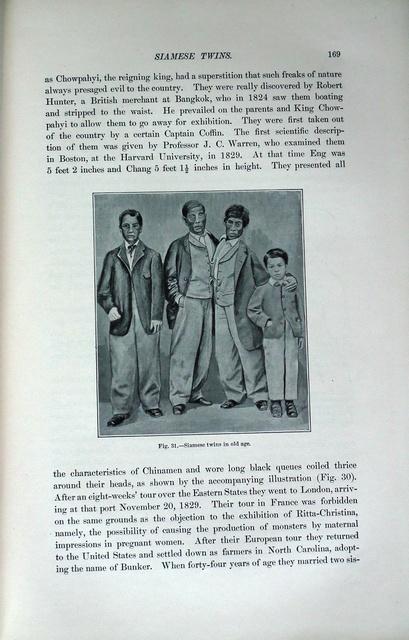
From the entry on “Siamese Twins” in Anomalies and Curiosities of Medicine

This “task” is underlined by Gould’s preface to Anomalies and Curiosities of Medicine (1896), whose comprehensive catalogue of medical abnormalities and monstrosities is meant to allow readers to “catch forbidden sight of the secret work-room of Nature, and drag out into the light the evidences of her clumsiness, and proofs of her lapses of skill,–evidences and proofs, moreover, that tell us much of the methods and means used by the vital artisan of Life,–the loom, and even the silent weaver at work upon the mysterious garment of corporeality.”

Gould’s cataloguing of medical anomalies was a decisive influence on his conception of Biologos as a constrained deity, working with recalcitrant materials, requiring the cooperation of His human creations to complete the “vitalization of dead matter and mechanical nature,” a view he used his considerable influence as a medical writer, editor and lexicographer to promulgate.

Gould’s “Biologos” was taken up by other writers through to the 1920s (for example, it features prominently in Theodore Dreiser’s 1915 novel The Genius) and became one among many popular attempts to synthesize Darwin and Christianity in the era of the Scopes Monkey Trial, anticipating many versions of “intelligent design” which persist today.

Cosmic Horror: Lovecraft’s Transvaluation

Probably the most direct and best documented literary source of Lovecraft’s conception of cosmic horror is Blackwood’s “The Willows,” which Lovecraft described as the “foremost” of Blackwood’s fictions for the “impression of lasting poignancy” it evokes.

“The Willows” details “a singular emotion” closely related to, but distinct from, natural sublimity, in which “delight of the wild beauty” mingles with “a curious feeling of disquietude, almost of alarm” that “lay deeper far than the emotions of awe or wonder,” due to the narrator’s “realization of our utter insignificance before this unrestrained power of the elements.” The primary difference between this and Gould’s description of cosmic horror is that Blackwood presents a simultaneous commingling of horror and awe, rather than the resolution of the former into the latter.

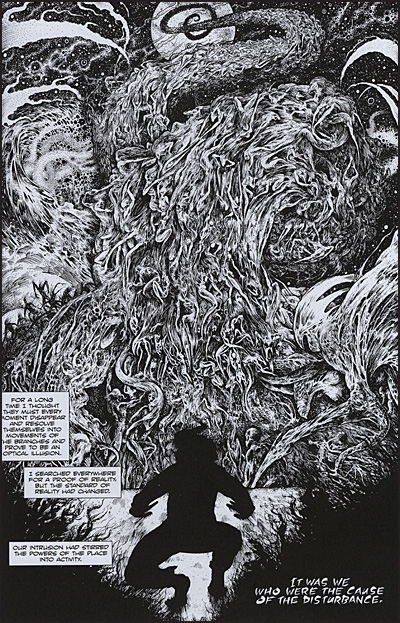
One of Sam Ford’s stunning illustrations for a contemporary graphic adaptation of “The Willows”

Lovecraft consistently follows Blackwood in presenting cosmic horror as a “sense of awe” “touched somewhere by vague terror,” and thereby implicitly rejects the “sublime turn” which is the conceptual crux of Gould’s theologically freighted concept.

For Gould, cosmic horror is a pathology and an obstacle, one that must be overcome by faith in the natural divinity Gould calls Biologos. For Lovecraft, it is instead an ambition and an invitation to the speculative exploration of the consequences of a vast, complex and indifferent universe. Lovecraft applies this transfigured conception to works of literature and art that convey the abyssal contrast between a belief in human exceptionalism grounded in the persistent, palliative notion that we are made “in the image” of a benevolent creator, and the reality that we are but one species among tens of thousands, struggling for survival on one planet among millions, in a universe whose virtually infinite reaches are beyond our paltry epistemic grasp, and from which we will one day pass, leaving no more than a tiny ripple in the oceanic expanses of space and time.


For further exploration of contemporaneous influences on Lovecraft’s conception of cosmic horror, read my essay “Lovecraft, Lucretius, and Leonard’s Locomotive-God”:

Tagged , , , , , , , , , , , , , , , ,